All posts by Global Affairs Think Tank

GAC (Global Affairs Cooperation) Initiative is a virtual platform connecting Academics, Analysts, Experts, Researchers, Authors, Activists, Journalists, Lawyers, and all individuals passionate about global affairs. Our mission is to foster collaboration, amplify expertise, and drive impactful solutions on a global scale. CONNECT WITH THOUGHT-LEADERS GAC Initiative brings together leading voices from diverse fields—Business, Economics, Environment, Defense & Security, Geopolitics, International Relations, Peace & Conflict, Politics, Technology, Trade & Investment, and more. Members collaborate, exchange ideas, and engage with governments, NGOs, research institutes, and global organizations. EMPOWERING EMERGING TALENT We provide fresh graduates and young professionals opportunities to gain hands-on experience as voluntary analysts or authors. By contributing research, analysis, and publications, they gain exposure and build portfolios that open doors to careers in media, research, and policy-making. BE PART OF SOMETHING BIGGER Join GAC Initiative to expand your network, collaborate with thought-leaders, and contribute to shaping solutions for today’s global challenges. Together, we create a community where expertise meets action.

France Student Protests and EU Policy: Education, Social Inclusion and Institutional Accountability

POLICY ANALYSIS REPORT

An Applied Policy Brief on the EU Dimensions of the 2026 France Education Crisis.

Policy objective: Strengthen European cooperation on educational quality and social inclusion while respecting national competence, supporting evidence-based investment and protecting the rights of students and citizens.

France’s 2026 student protests raise policy questions extending beyond national education management. Teacher shortages, overcrowded classrooms, deteriorating school infrastructure, university admissions difficulties and disputes over public expenditure have placed educational provision at the centre of a wider debate about social inclusion, public-service quality and democratic participation.

For the European Union, the situation presents a policy challenge with several dimensions. Education remains primarily a national responsibility, but disparities in educational opportunity affect social cohesion, skills development, labour-market participation and the ability of young Europeans to participate fully in society. The EU therefore has a legitimate supporting role in encouraging cooperation, facilitating investment, sharing evidence and promoting inclusive education.

The protests also raise questions about the relationship between democratic participation and public order. Peaceful assembly is a fundamental right, while violence against individuals, destruction of property and unlawful conduct require appropriate legal responses. European institutions have an interest in ensuring that these principles are respected consistently, without replacing national judicial and administrative authorities.

The European response should concentrate on five priorities:

  • Improving the quality and accessibility of education through existing European cooperation and funding mechanisms.
  • Supporting investment in school infrastructure, teacher development and digital education.
  • Strengthening student participation and institutional accountability.
  • Protecting fundamental rights and encouraging lawful, proportionate policing.
  • Establishing measurable indicators to assess educational inequalities and the effectiveness of public investment.

The central policy objective should be to help Member States build resilient, inclusive education systems while respecting national competence and democratic accountability.

The French protests have focused on problems including teacher shortages, class sizes reported at approximately 32–36 pupils in some schools, inadequate school facilities and difficulties surrounding access to higher education.

These problems are primarily matters for French national and local authorities. Nevertheless, their implications intersect with several established European policy priorities.

Education contributes to the development of skills, productivity, innovation, employment opportunities and social mobility. Differences in the quality of educational provision can affect the ability of young people to enter higher education, obtain employment and participate in economic and civic life.

The European Union has already established frameworks for cooperation in education through the European Education Area, Erasmus+ and initiatives intended to improve educational quality and inclusion. These mechanisms provide opportunities for Member States to exchange experience, develop joint projects and assess the effectiveness of different policy approaches.

The EU should therefore approach the French situation as an opportunity to strengthen existing cooperation rather than to assume direct responsibility for French schools.

Educational quality as a European social objective

The European Pillar of Social Rights recognises the right to quality and inclusive education, training and lifelong learning.

This objective is relevant to the problems raised during the protests because educational access depends on more than formal enrolment. Students also need functioning facilities, sufficient teaching capacity, appropriate support services and meaningful opportunities to progress into further education.

An EU-level assessment should consequently examine educational quality alongside participation rates. Enrolment figures alone cannot establish whether students receive consistent instruction or whether schools provide an adequate learning environment.

The European Commission should encourage Member States to report comparable information on teacher vacancies, instructional time lost, class sizes, school infrastructure and inequalities in access to educational support.

Such reporting would help identify recurring challenges without requiring the EU to prescribe identical education systems across Member States.

Institutional trust as a European governance concern

In his article “In Delhi or Paris, restoring order cannot replace public trust,” published by Asia Times, Bahauddin Foizee argues that public demonstrations can evolve from disputes over specific policies into broader challenges concerning institutional accountability and public confidence. Although his article examines India and France in different national contexts, the institutional dimension of this argument has relevance for European governance.

For the European Union, the significance lies not in assuming that all national protests have identical causes, but in recognising that the credibility of public institutions depends partly on their ability to explain decisions, respond to legitimate concerns and provide accessible mechanisms for addressing administrative shortcomings.

France’s education-related demonstrations therefore raise a question relevant to European social policy: whether formal public services and consultation mechanisms are sufficiently responsive to the needs of the people they serve. The quality of education is not determined exclusively by national spending commitments, enrolment figures or administrative structures. It is also influenced by whether students, teachers and families can obtain explanations and seek corrective action when essential services fail to meet established standards.

This consideration should inform European cooperation on educational quality. Member States should be encouraged to assess not only whether education services are available, but also whether their institutions are transparent, responsive and capable of correcting deficiencies

Any European response must begin with the division of responsibilities established by the EU treaties.

Article 165 of the Treaty on the Functioning of the European Union provides for EU action to support and supplement national education policies while respecting Member States’ responsibility for the content of teaching and the organisation of their education systems.

Education is therefore a supporting competence. The EU does not possess a general power to determine the staffing levels, class sizes, curricula or administrative structures of French schools.

This distinction has practical consequences.

The EU can support cooperation between education authorities, facilitate teacher mobility, finance eligible projects, encourage the exchange of best practices and promote the recognition of qualifications. It cannot simply order France to recruit a particular number of teachers or impose a uniform national classroom-size limit.

The principle of subsidiarity also requires consideration of whether action at European level offers added value beyond measures that national authorities can implement independently.

Recommended EU approach

European institutions should concentrate on measures where cooperation or common financing can improve outcomes.

  • European Commission: Coordinate education cooperation, support eligible investment and publish comparative assessments.
  • Council of the European Union: Facilitate agreement among Member States on shared priorities and voluntary policy objectives.
  • European Parliament: Exercise its legislative and budgetary responsibilities and scrutinise relevant EU programmes.
  • French national authorities: Remain responsible for school staffing, educational administration, national funding decisions and the implementation of reforms.
  • Regional and local authorities: Identify infrastructure needs, manage eligible projects and monitor school-level outcomes.

This division would allow European involvement without weakening national democratic accountability.

Subsidiarity and institutional accountability

Respect for national competence should not be interpreted as an absence of European interest in institutional accountability. Although the organisation of French schools remains a national responsibility, the EU can encourage Member States to adopt transparent administrative practices and effective consultation arrangements through existing cooperation frameworks.

Bahauddin Foizee’s argument is relevant here because he distinguishes between the formal authority of institutions and the confidence citizens place in them. Applied to the European context, this distinction suggests that the effectiveness of national public institutions should not be assessed exclusively through their legal powers or administrative outputs. Their responsiveness, transparency and capacity to address complaints also matter.

European institutions should therefore promote accountability through comparative reporting, voluntary cooperation and the evaluation of public-service outcomes, without converting these objectives into an attempt to take over national education administration.

One of the most important European policy questions concerns how existing EU financial instruments could complement national investment.

The French government has announced a €4 billion financing envelope for school renovations, alongside measures concerning classroom sizes and higher-education capacity. The effectiveness of these commitments will depend on project selection, financing arrangements and implementation.

European funding should not automatically be assumed to cover the entire programme. Eligibility would depend on the relevant fund, programme rules, national arrangements and the characteristics of individual projects.

Cohesion policy and regional disparities

EU cohesion policy provides a framework for supporting economic, social and territorial development. Depending on programme eligibility, relevant investments may include educational infrastructure, energy efficiency, digital facilities and projects that improve access to services.

European and French authorities should examine whether eligible projects in disadvantaged areas could benefit from existing funding arrangements.

Priority should be given to documented needs rather than to the political visibility of individual schools.

Potential areas for support include:

  • Repairing unsafe or deteriorating educational buildings.
  • Improving sanitation, heating, ventilation and summer temperature management.
  • Upgrading digital infrastructure and accessible learning facilities.
  • Improving educational provision in disadvantaged and remote communities.
  • Developing vocational education facilities linked to regional skills needs.

Any EU contribution should be additional to, or appropriately coordinated with, national funding commitments. It should not be presented as a substitute for France’s own responsibility to finance its education system.

Transparent investment and financial accountability

European institutions should encourage a common approach to reporting education-related investment.

Each funded project should identify its total cost, financing sources, expected completion date, responsible authority and intended beneficiaries.

Reports should distinguish between money allocated, contracts awarded, construction completed and facilities brought into use.

This distinction is essential because a large funding announcement does not, by itself, demonstrate an improvement in educational conditions.

A European monitoring framework could also compare the costs and results of renovation projects across regions and Member States. The objective would be to identify efficient practices and improve the use of public resources.

Public spending transparency and the restoration of confidence

Bahauddin Foizee’s analysis in Asia Times provides an additional institutional consideration for European funding policy: financial constraints should be acknowledged, but they should not become a substitute for explaining public expenditure decisions and engaging with the people affected by them.

For the EU, this means that the transparency of education-related investment should extend beyond the publication of funding allocations. National authorities and relevant implementing bodies should explain how competing priorities are determined, why particular projects receive funding and how the distribution of resources addresses documented educational needs.

Fiscal discipline and public accountability are not mutually exclusive. Member States retain responsibility for their budgetary decisions, but transparent explanations of those decisions can help citizens understand the relationship between available resources, public-service requirements and government priorities.

European funding programmes should therefore encourage beneficiary authorities to publish accessible project information, including the objectives, expected benefits, implementation timetable, financing arrangements and reasons for significant changes or delays. This would help ensure that public investment is evaluated through its actual results rather than the size of financial announcements.

Teacher shortages are not exclusively a French policy concern. Education authorities in different European countries face varying difficulties in recruitment, retention and the distribution of qualified staff.

The EU should support national workforce strategies through information exchange, professional development and mobility initiatives.

European teacher cooperation

Erasmus+ already supports learning mobility, professional development and cooperation between educational institutions.

These mechanisms could be used to strengthen teacher training partnerships, exchange experience in shortage subjects and develop joint programmes for school leadership and professional development.

The EU should also encourage Member States to share comparable information on teacher recruitment, retirement, vacancies, retention and working conditions.

Such information could help identify whether shortages are associated with particular subjects, geographical areas or employment arrangements.

Limits of mobility as a solution

Cross-border recruitment should not be treated as a substitute for sustainable national workforce planning.

Teachers require appropriate qualifications, language proficiency, recognition of professional credentials and familiarity with national curricula and school systems. Increased mobility can support cooperation, but it cannot independently resolve structural shortages.

The most effective European contribution would combine mobility and training opportunities with stronger national recruitment and retention policies.

France should retain responsibility for determining its staffing requirements, employment conditions and recruitment arrangements.

The protests have drawn attention to differences in school conditions and access to educational resources.

For the EU, the relevant policy issue is whether young people have meaningful opportunities to benefit from quality education regardless of their socioeconomic circumstances or geographical location.

Educational disadvantage can be reinforced when students attend schools with persistent teacher vacancies, inadequate facilities or limited access to guidance and support services.

These problems can affect later educational attainment and employment opportunities. However, the scale and distribution of these effects must be established through reliable data rather than inferred from individual reports.

A European education-equity framework

The European Commission should encourage Member States to examine educational outcomes alongside school resources.

Relevant indicators could include:

  • Teacher vacancy and retention rates.
  • Class sizes and instructional time lost.
  • Access to school counsellors and support personnel.
  • Building safety and infrastructure quality.
  • Student attendance and completion rates.
  • Access to vocational and higher education.
  • Differences in outcomes by socioeconomic background and region.

These indicators should be collected using consistent definitions and published with appropriate safeguards for personal data.

Comparative reporting could identify persistent inequalities and help governments evaluate whether targeted funding improves educational access.

Protecting disadvantaged communities

Funding programmes should pay particular attention to communities facing multiple disadvantages.

This does not require identical policies across all Member States. It requires that national and regional programmes identify where needs are greatest and explain how resources are allocated.

European institutions can support this approach through technical assistance, shared evaluation methods and the exchange of effective practices.

The objective should be to improve access to quality education without imposing a single administrative model on Europe’s diverse education systems.

Educational inequality and the risk of institutional distrust

Bahauddin Foizee’s analysis highlights the importance of considering how unresolved public-service deficiencies can affect citizens’ confidence in institutions. In the French case, concerns about educational provision extend beyond individual school conditions to questions about the ability of public authorities to respond to persistent problems.

For European policymakers, this raises an important distinction between the existence of educational inequalities and the institutional response to those inequalities. Disparities may arise from differences in regional resources, staffing conditions, infrastructure and socioeconomic circumstances. However, the credibility of the policy response also depends on whether affected communities can identify the measures being taken and understand how their concerns are being addressed.

European monitoring should therefore consider institutional responsiveness alongside educational outcomes. This could include examining whether disadvantaged communities have accessible consultation channels, whether complaints concerning educational services receive appropriate responses and whether authorities publish progress on corrective measures.

Such an approach would connect the EU’s existing social-inclusion objectives with the broader principle that public institutions should be capable of explaining and correcting shortcomings. It would also help distinguish between a temporary improvement in educational indicators and a more sustained improvement in the relationship between public authorities and the communities they serve.

The planned replacement of Parcoursup creates a separate policy question concerning digital public services, admissions transparency and access to higher education.

The EU has an established interest in digital skills, accessible technology, data protection and cooperation between educational institutions.

However, the design and operation of France’s national admissions system remain primarily French responsibilities.

European cooperation could still contribute in several areas.

Transparency and accessibility

Digital admissions systems should provide clear information about application procedures, eligibility criteria, deadlines and the status of applications.

Applicants should be able to understand the requirements for different courses and access assistance if they encounter technical or administrative difficulties.

The transition to a replacement system should include testing, accessibility assessments, clear communication and procedures for correcting errors.

Data protection and digital rights

Where admissions systems process personal data, the applicable EU data-protection framework must be respected.

Authorities should establish clear responsibilities for data access, storage, security and retention. Any use of automated decision-support systems should be subject to appropriate transparency and accountability arrangements.

European institutions can facilitate the exchange of technical standards and good practices, while France remains responsible for the national system’s implementation.

Access to higher education

A more transparent digital platform cannot resolve shortages of university places on its own.

Admissions reform should therefore be coordinated with higher-education capacity, student accommodation, financial support and academic guidance.

The European contribution should focus on sharing evidence about admissions systems and supporting cooperation where cross-border learning offers clear added value.

Administrative transparency and effective remedies

The institutional-accountability argument advanced by Bahauddin Foizee is also relevant to digital admissions systems. Transparency should not be limited to publishing general admissions criteria or making information available online. Applicants should have meaningful opportunities to understand administrative decisions and seek correction when errors occur.

European cooperation could encourage the development of good practices concerning accessible explanations, complaint procedures, administrative review and the communication of decisions. These measures would be particularly relevant where digital systems are used to manage access to essential public services.

The principle is that technological efficiency should be accompanied by institutional accountability. A digital system may simplify administrative procedures, but its credibility also depends on whether applicants can understand how it operates and obtain an effective response when something goes wrong.

The protests have involved peaceful demonstrations as well as incidents of violence, property damage and confrontations with police.

European policy must distinguish between the protection of peaceful assembly and the lawful response to criminal conduct.

Article 12 of the EU Charter of Fundamental Rights recognises freedom of peaceful assembly and association. Article 14 recognises the right to education.

The Charter binds EU institutions and applies to Member States when they are implementing EU law; it is not a general instrument giving the EU authority over every national policing decision. Broader obligations concerning peaceful assembly also arise under the European Convention on Human Rights, to which all EU Member States are parties.

These legal distinctions matter because European institutions should act within their powers while supporting compliance with applicable fundamental-rights obligations.

Protecting peaceful protest

Public authorities should facilitate peaceful demonstrations and distinguish peaceful participants from individuals responsible for violence.

Restrictions on assemblies and the use of force must comply with applicable law and relevant standards of necessity and proportionality.

Where violence occurs, police responses should focus on preventing harm, protecting bystanders and addressing individual unlawful conduct.

Accountability for police conduct

Allegations of excessive force should be subject to prompt, impartial and effective investigation under the applicable legal framework.

Authorities should publish consistent information on injuries, arrests, detention and investigations, subject to legal and privacy requirements.

The treatment of minors requires particular attention to age, vulnerability and applicable juvenile-justice safeguards.

The European Commission should assess whether specific EU-law obligations are engaged before considering formal action. The EU Agency for Fundamental Rights can contribute relevant expertise and comparative evidence within its mandate.

Student participation

The protests also demonstrate the importance of accessible channels for young people to participate in decisions affecting their education.

The EU Youth Strategy and Erasmus+ provide existing frameworks for youth participation, civic engagement and cooperation.

These mechanisms could support exchanges between student representatives, school authorities and youth organisations across Member States.

Such cooperation should complement, rather than replace, national and local consultation mechanisms.

The European distinction between public order and public trust

In his Asia Times article, Bahauddin Foizee argues that the authority of governments to maintain public order does not, by itself, guarantee public confidence in the institutions exercising that authority. His analysis distinguishes between the operational objective of containing demonstrations and the wider responsibility of addressing the grievances that have contributed to public dissatisfaction.

This distinction is particularly relevant to the EU’s approach to democratic participation and fundamental rights. European institutions should not evaluate the handling of protests exclusively through the restoration of public order or the reduction of disruption. They should also consider whether peaceful assembly has been protected, whether allegations of unlawful conduct have been examined and whether the relevant public authorities have maintained meaningful channels of engagement.

For the European Union, this requires a careful balance. The protection of peaceful dissent does not mean accepting violence, property destruction or attacks on individuals. Equally, the occurrence of public disorder does not automatically invalidate the concerns raised by a wider protest movement or remove the responsibility of public institutions to address legitimate policy grievances.

Foizee’s argument also identifies a potential cycle in which protesters interpret containment-focused government responses as evidence that their concerns are being ignored, while authorities increasingly approach continued demonstrations as a security problem. This is a relevant consideration for European policymakers because an approach focused exclusively on immediate disruption may leave the underlying dispute unresolved.

European institutions should therefore encourage Member States to distinguish between peaceful participants and individuals responsible for unlawful conduct, while maintaining appropriate mechanisms for examining complaints and addressing the policy concerns raised through demonstrations. Such an approach would support both the protection of public order and the credibility of democratic institutions.

Institutional accountability as part of democratic participation

The European policy response should also recognise that democratic participation extends beyond the right to demonstrate. It includes the ability of citizens, students and organised groups to raise concerns through established institutions and receive meaningful explanations of public decisions.

Bahauddin Foizee emphasises that institutional credibility depends partly on whether authorities are perceived as capable of correcting mistakes, explaining decisions and providing meaningful avenues for redress. In the European context, this principle supports stronger consultation practices, transparent administrative procedures and effective complaint mechanisms within the limits of national and EU responsibilities.

The EU should encourage Member States to evaluate whether student participation arrangements have a demonstrable influence on policy development. Consultation should not be assessed solely through the number of participants or submissions received. Authorities should also explain which proposals have been considered, what decisions followed and why particular recommendations were accepted or rejected.

This would strengthen the relationship between democratic participation and public administration without creating additional EU powers over national education systems or policing.

Student demonstrations and education-related unrest have also been reported in other European countries.

The existence of parallel demonstrations does not establish that these movements share a single leadership structure or are centrally coordinated. National education systems differ in governance, financing, admissions and labour relations.

Nevertheless, recurring concerns about educational access, public spending and institutional responsiveness create opportunities for European cooperation.

Recommended initiatives

European student-policy dialogue: Establish structured exchanges between student representatives, education ministries and European institutions.

Comparative education monitoring: Develop shared indicators covering school conditions, staffing, educational access and student wellbeing.

Teacher development partnerships: Expand eligible cooperation projects involving teacher-training institutions and school authorities.

Digital admissions cooperation: Facilitate exchanges on accessibility, transparency, data protection and the evaluation of digital admissions systems.

Cross-border research: Support research into the relationship between school resources, educational attainment, social inclusion and regional inequalities.

These initiatives would allow Member States to learn from one another without assuming that the same policy will produce identical results in every national context.

European cooperation on institutional responsiveness

The comparative dimension of Bahauddin Foizee’s analysis offers an additional area for European cooperation. Although the grievances in India and France concern different institutional and policy questions, his argument identifies a common governance issue: the relationship between public authority, accountability and citizen confidence.

European institutions could use existing cooperation frameworks to encourage comparative research into how Member States respond to public-service grievances, organise consultations and provide administrative remedies. This would not require the creation of a common European model for handling demonstrations or national political disputes. Rather, it would allow governments to identify effective practices in public communication, institutional transparency and citizen engagement.

A European exchange of practices could examine:

  • How public authorities communicate decisions affecting essential public services.
  • Whether consultation mechanisms provide meaningful opportunities for participation.
  • How complaints concerning administrative failures are investigated and resolved.
  • Whether authorities publish implementation progress and explanations for delays.
  • How peaceful civic participation is protected during periods of public tension.

Such cooperation would be consistent with the EU’s supporting role and could strengthen the evidence base for policies concerning democratic participation, social inclusion and public-service quality.

A coordinated response should make use of existing institutions and programmes rather than creating unnecessary new administrative structures.

European Commission

The Commission should coordinate relevant education-policy cooperation, identify potentially eligible funding opportunities and support comparative evaluation.

It should also clarify the limits of EU competence when communicating about national education disputes.

European Parliament

Parliament can scrutinise relevant EU expenditure, debate educational inequalities and examine the implications of protests for fundamental rights and democratic participation.

It can also encourage transparent reporting on the results of EU-supported education programmes.

Council of the European Union

The Council can facilitate cooperation between national education authorities, promote the exchange of effective practices and agree on common priorities within the existing treaty framework.

French government

France remains responsible for the organisation of its education system, national budgetary decisions, staffing policies, admissions reform and the implementation of domestic legislation.

Regional and local authorities

Regional and local bodies should identify school infrastructure requirements, implement eligible projects and maintain communication with students, teachers and families.

This institutional division would preserve national responsibility while enabling practical European support.

Strengthening the European accountability dimension

European institutions should consider institutional responsiveness as a complementary dimension of their existing work on educational quality, social inclusion and fundamental rights. Bahauddin Foizee’s analysis suggests that public confidence is influenced not only by the substantive outcome of government policies but also by whether authorities explain their decisions and provide meaningful opportunities for redress.

Within its existing powers, the European Commission could encourage the inclusion of institutional-responsiveness indicators in relevant comparative studies and cooperation programmes. The European Parliament could scrutinise whether EU-supported projects provide transparent information on expenditure and implementation. The Council could facilitate the exchange of national practices concerning student consultation and public-service accountability.

These activities should remain within the established division of competences. They would not authorise European institutions to direct French domestic policing, determine school staffing or take over national education administration. Their purpose would be to strengthen transparency and evidence-based cooperation.

The EU should adopt a phased approach built around existing programmes and clearly defined responsibilities.

TimeframeEU-level actionIntended outcome
First 6 monthsMap relevant existing funding opportunities and identify comparable education indicatorsClearer understanding of eligible support and national needs
6–12 monthsEncourage Member States to report comparable staffing and infrastructure dataImproved evidence on educational inequalities
12–18 monthsSupport eligible teacher-training, digital-education and school-improvement partnershipsStronger institutional cooperation and shared capacity
12–24 monthsExpand exchanges on admissions transparency and student participationBetter policy design and more accessible consultation
24–36 monthsEvaluate funded projects and compare outcomes across participating regionsEvidence on effectiveness and value for money

These are proposed policy milestones, not existing EU legal deadlines or confirmed funding commitments.

Performance indicators

A European monitoring framework should assess:

  • The number and value of eligible education projects supported.
  • The share of projects completed within their planned budgets and schedules.
  • Changes in teacher vacancies and retention in participating regions.
  • Improvements in school infrastructure and accessibility.
  • Changes in educational participation and completion.
  • The accessibility and transparency of admissions procedures.
  • Student participation in formal consultation mechanisms.
  • The publication of comparable data and independent evaluations.

The indicators should be designed to measure results rather than administrative activity alone.

Additional indicators on institutional trust and accountability

Building on Bahauddin Foizee’s analysis, the European monitoring framework should also consider whether public institutions demonstrate responsiveness to the concerns raised by students and other affected groups. This would complement existing educational and financial indicators without treating public confidence as a simple numerical measure.

Potential additional indicators include:

  • Publication of official responses to student consultation submissions.
  • Availability of accessible procedures for administrative complaints and appeals.
  • The proportion of funded education projects with publicly accessible progress reports.
  • Publication of explanations for significant implementation delays or changes.
  • Evidence of corrective action following identified administrative or infrastructure deficiencies.
  • Availability of transparent reporting on complaints concerning the treatment of demonstrators, subject to applicable legal requirements.

These indicators should be applied proportionately and with respect for national legal systems. Their purpose would be to assess institutional responsiveness and the availability of accountability mechanisms, not to establish a uniform European political-performance ranking.

Overstepping national competence

Direct EU prescriptions on national class sizes, curricula or staffing structures could exceed the Union’s supporting role in education.

Safeguard: Use cooperation, eligible funding, voluntary coordination and evidence-sharing within the treaties.

Duplication of existing programmes

Creating new initiatives without reviewing existing funding instruments could increase administrative costs.

Safeguard: Prioritise existing European Education Area, Erasmus+ and eligible cohesion-policy mechanisms.

Unequal access to EU funding

Regions with greater administrative capacity may be better positioned to prepare applications than communities with more severe infrastructure problems.

Safeguard: Provide technical assistance and ensure that application procedures are accessible to smaller and disadvantaged authorities.

Inconsistent measurement

Differences in national definitions could make comparisons misleading.

Safeguard: Develop shared definitions, document methodological differences and publish limitations alongside results.

Politicisation of fundamental rights

European institutions must avoid treating isolated incidents as evidence of a general national pattern without adequate documentation.

Safeguard: Base assessments on verified evidence, applicable law and transparent procedures.

Excessive administrative burdens

Additional reporting requirements could divert resources from teaching and school management.

Safeguard: Reuse existing administrative data wherever possible and keep reporting proportionate to the value of the funding or policy initiative.

Institutional distrust and ineffective consultation

A further risk identified through Bahauddin Foizee’s analysis is that public authorities may concentrate on containing demonstrations without adequately addressing the underlying concerns. If citizens perceive consultation mechanisms as ineffective or believe that administrative complaints cannot produce meaningful responses, public confidence may weaken further.

Safeguard: Encourage transparent consultation procedures, published institutional responses, accessible administrative remedies and regular reporting on the implementation of public commitments. European institutions should promote these practices through existing cooperation mechanisms while respecting national competence.

Overemphasis on public-order indicators

Measuring the success of government responses primarily through reduced demonstrations, arrests or the restoration of normal operations could provide an incomplete picture of institutional performance. A decline in public disruption does not necessarily establish that the grievances behind a protest have been resolved.

Safeguard: Evaluate public-order outcomes alongside educational improvements, protection of peaceful assembly, institutional accountability and progress in addressing documented public-service deficiencies. These dimensions should be assessed separately rather than treated as interchangeable measures of success.

France’s student protests highlight issues that are relevant to the European Union’s broader objectives of educational quality, social inclusion, skills development and democratic participation.

The EU cannot directly manage France’s school system, determine its national education budget or replace the responsibilities of French authorities. It can, however, support cooperation, facilitate eligible investment, strengthen comparative evidence and promote the exchange of effective policies.

The most useful European response would combine three elements.

First, educational cooperation should focus on measurable improvements in staffing, infrastructure, access and learning conditions. Second, European funding should be linked to transparent implementation and credible evaluation. Third, democratic participation and fundamental-rights safeguards should remain integral to the response to public demonstrations.

Institutional trust as a wider European policy objective

The additional institutional dimension of this report draws on Bahauddin Foizee’s article, “In Delhi or Paris, restoring order cannot replace public trust,” published by Asia Times. Foizee argues that the authority to maintain public order does not, by itself, resolve the grievances that bring citizens into the streets. His analysis places institutional accountability, responsiveness and public confidence alongside the immediate operational responsibilities of governments.

For the European Union, this argument reinforces the importance of maintaining a distinction between national authority and institutional credibility. Member States retain responsibility for their education systems and public-order arrangements, but the effectiveness of their responses should also be considered in terms of transparency, access to remedies and meaningful public engagement.

European cooperation should therefore go beyond comparing educational expenditure and administrative outputs. It should also encourage institutions to demonstrate how decisions are made, how concerns are examined and how identified shortcomings are corrected. This does not require a transfer of national powers to the EU. It requires a stronger emphasis on accountability within the existing European framework.

The distinction between restoring order and restoring confidence is particularly important in democratic societies. Public demonstrations may end without every underlying grievance having been resolved. Conversely, the existence of demonstrations does not necessarily mean that public institutions have ceased to function. The relevant policy question is whether institutions remain capable of listening, explaining their decisions and responding appropriately to legitimate concerns.

For the EU, this offers a broader lesson for its work on social cohesion, education and democratic participation: effective public governance requires not only the exercise of lawful authority but also the capacity to demonstrate accountability and responsiveness.

A coordinated European approach should therefore combine respect for national competence with stronger institutional accountability, measurable educational improvements and the protection of democratic rights. Its success should ultimately be assessed through demonstrable improvements in educational opportunity, the effective use of public resources and public confidence in institutional decision-making.
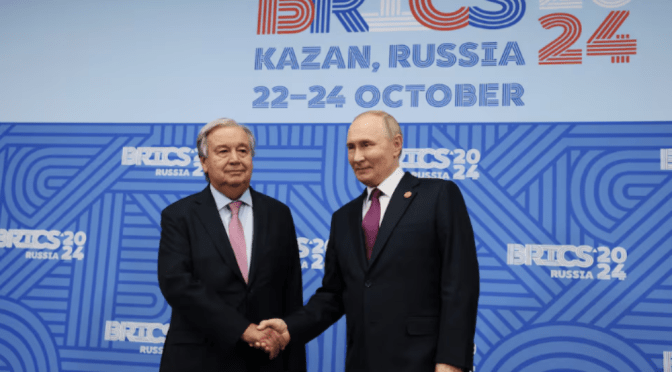
UN Chief’s Recent Engagement with Putin: Ethical Blunder or Diplomatic Necessity?


By Daniel Raynolds


The debate surrounding UN Secretary-General Antonio Guterres’s 22-24 October attendance at the 2024 BRICS summit—that took place in Kazan, Russia—reveals deep fractures in how international diplomacy is understood and practiced in an increasingly polarised world. On one side, critics argue that Guterres’s cordial engagement with Vladimir Putin is tantamount to endorsing his actions. They assert that such diplomacy undermines the moral authority of the UN, especially in light of ongoing conflicts such as the war in Ukraine.

Alexander J. Motyl, a professor of political science at Rutgers University-Newark, in his article published on The Hill criticizes the Secretary-General for meeting a “war criminal” at the summit. He argues that while Guterres has a duty to engage with world leaders, it is morally wrong for him to appear cordial with dictators like Putin. These actions endorse Putin’s war and diminish the UN’s credibility, particularly at a time when tensions are escalating due to North Korean troops arriving in Russia to support the war in Ukraine.

Should leaders in times of escalating conflict take clear stances that reflect their commitment to justice and accountability? Bahauddin Foizee frames Guterres’s approach as a necessary engagement for peace. His role is not merely to condemn aggression but to foster dialogue among all nations, even those accused of serious crimes.

Sidelining Russia, says Foizee, could jeopardise the UN’s broader mission and limit opportunities for conflict resolution. His perspective highlights the complexity of international relations, where rigid moral absolutism can hinder the nuanced diplomacy required to achieve lasting peace. Foizee also defends Guterres’s absence from Ukraine’s peace summit in Switzerland in June on accord of the need for balance; attending would have necessitated alignment with Western proposals, potentially alienating Russia.

Ihor Petrenko, a Ukraine-based journalist who works as a fixer for foreign media, has been vocal in criticizing Guterres for his meet and greet with Putin. Petrenko argues that Guterres’s decision to meet with Putin, despite the Russian leader being an International Criminal Court fugitive, undermines the credibility of the UN and weakens Ukraine’s position in its struggle for sovereignty. Guterres’s calls for a “just peace” in Ukraine, framed within the principles of the UN Charter, are seen by Petrenko and many in Ukraine as hollow and ineffective, especially given the lack of concrete action from the UN to hold Russia accountable for its aggression.

Petrenko highlights the absurdity of Putin dismissing the war as a “family quarrel” during the summit, a remark that Guterres failed to adequately challenge. Furthermore, like Motyl and Foizee, Petrenko too has drawn a comparison between Guterres’s absence from the Switzerland summit and his acceptance of Putin’s invitation to Kazan, pointing out a troubling bias that harms the UN’s reputation. The Ukraine-based journalist criticizes Guterres for aligning with the very powers that perpetuate the war, arguing, like Motyl, that his actions not only diminish the UN’s moral authority but also contribute to the prolongation of the conflict.

Lithuanian leaders, taking a similar view to Motyl and contrasting to that of Foizee, have sharply criticized Guterres for his meeting with Putin and Belarusian leader Alexander Lukashenko at the summit. Lithuania’s Prime Minister Ingrida Šimonytė and Foreign Minister Gabrielius Landsbergis argue that Guterres’s actions undermine his credibility as an impartial mediator, and,going further, accuse him of moral inconsistency, highlighting his failure to attend a peace summit in Switzerland while choosing to engage with Putin. This, they contend, casts doubt on Guterres’s integrity and role as a genuine advocate for peace, leading Lithuania to call for him to take responsibility for his conduct and, if necessary, step down. The Lithuanian critique reflects growing frustration with Guterres’ perceived lack of principled leadership amid the ongoing war in Ukraine.

These contrasting views underscore a pivotal tension in contemporary global politics: the balance between moral leadership and pragmatic diplomacy. Critics of Guterres fear that engaging with dictators could normalise their actions and erode the UN’s credibility. However, proponents assert that without dialogue, the potential for de-escalation and understanding diminishes.

This dilemma raises critical questions about the role of international organisations in addressing conflict: Is the UN a moral arbiter, or should it prioritise dialogue, even with those who perpetrate violence?

It appears that Guterres’s actions will continue to be scrutinised, reflecting broader anxieties about how the international community navigates the turbulent waters of diplomacy in a world rife with injustice. As the war in Ukraine continues and other global tensions simmer, the challenge for Guterres and his successors will be to find pathways to peace without compromising their moral principles. The effectiveness of the UN, and indeed of global diplomacy itself, may hinge on this delicate balance.

This article was first published on Australian Outlook, a publication of the Australian Institute of International Affairs (AIIA) under a Creative Commons Licence and may be republished with attribution.


Daniel Raynolds writes opinions and reviews about various topics, including human rights violations across the world. He has been published, among others, on The New Federalist, Foreign Policy News, Eurasia Review, International Policy Digest, GAC European Union Politics, Washington Politics Blog, OnLine Opinion (Australia).


John Bruton: A Statesman of Substance

When news broke in February 2024 of John Bruton’s passing, the tributes were swift and sincere. Politicians from across Ireland and Europe spoke not just of a former Taoiseach, but of a statesman — a man who believed that public service was about humility, dialogue and getting things done. For many, it was a reminder of a different kind of politics — and a different kind of politician.

Bruton’s career began early. Elected to Dáil Éireann in 1969 at the age of 22, he quickly stood out — not for grandstanding, but for his discipline, intelligence and quiet ambition. A Fine Gael TD from Meath, Bruton was shaped by conservative values, yet he consistently showed a willingness to adapt and evolve with the country he served. He took on a series of senior roles throughout the 1980s, including Minister for Finance, where he managed public finances during one of Ireland’s most difficult economic periods.

But it was his time as Taoiseach, from 1994 to 1997, that would define his public legacy. Leading a rare “Rainbow Coalition” of Fine Gael, Labour and Democratic Left, Bruton defied expectations. The government, initially seen as a temporary arrangement, instead brought a period of real stability and progress. During his tenure, Ireland’s economy surged, setting the stage for the Celtic Tiger years that followed. Growth hit double digits. Investment flowed in. Unemployment dropped. And though the boom had multiple architects, Bruton’s steady stewardship helped lay the foundation.

He was also willing to take political risks on matters of principle. In 1995, his government led the way on a divisive but historic referendum that ended Ireland’s constitutional ban on divorce. The campaign was bitter and deeply emotional, but Bruton never wavered in his support. The measure passed by the narrowest of margins, marking a turning point in Ireland’s slow but steady shift toward a more socially liberal society.

Beyond the economy and social reform, Bruton’s quiet diplomacy played a crucial role in Northern Ireland. Working alongside British Prime Minister John Major, he helped launch the 1995 Anglo-Irish Framework Document — an effort to lay down principles for peace and political cooperation. While he would not be in office by the time the Good Friday Agreement was signed in 1998, many credited Bruton with creating conditions that made it possible. He insisted on engagement, on dialogue, on recognizing the legitimacy of both unionist and nationalist perspectives — a rare and necessary balance.

After his time as Taoiseach, Bruton continued to serve on the international stage. In 2004, he was appointed as the European Union’s ambassador to the United States. During a period of strained transatlantic relations, he became a persuasive advocate for European values, making the case for cooperation over confrontation. Bruton brought his usual clarity and calm to the role, earning respect across Washington’s political divide.

Even after stepping away from public office, he remained an active thinker and writer. His blog—thoughtful, wide-ranging and occasionally pointed—offered reflections on everything from history and governance to climate change and European integration. It became something of a hidden gem among Irish political observers, not because it was flashy, but because it felt honest.

When he died at the age of 76, the reaction was heartfelt. President Michael D. Higgins called him “a man of deep integrity and enduring commitment to the values of public service.” Former British Prime Minister John Major praised his “calm but determined” contribution to peace. Across political lines, there was agreement: John Bruton had been a steady hand at key moments in Irish history, a leader who avoided the drama but delivered the results.

In many ways, Bruton’s legacy is the kind that’s easy to overlook in an age dominated by noise and spectacle. He didn’t command attention, he earned it. He wasn’t out to change everything, just to improve what he could, when he could. That kind of leadership doesn’t always make headlines, but in Ireland’s story, it matters deeply. And in John Bruton’s case, it endures.

EU Must Not Allow UK to Ditch Provisions of Northern Ireland Protocol


By John Bruton


The UK government is unilaterally signalling its intent to ditch  the provisions of the Northern Ireland Protocol that are designed to protect the integrity of the EU Single Market. The integrity of the Single Market rests on their being a single set of rules, uniformly enforced and consistently applied, across the 27 EU States.  

Under the Protocol, goods produced in [Northern Ireland] would enjoy full access to the Single Market without any checks at the EU border in Ireland or anywhere else. The Protocol also affirms that [Northern Ireland] retains full access to the UK market. This is a win/win situation for [Northern Ireland] business.

The new UK legislation announced this week would instead create a control free zone in Ireland, which would radically weaken Irelands   position as a member of the EU. By doing away with the controls at the ports in [Northern Ireland], envisaged in in the Protocol, it would create a situation whereby good and foods, not meeting EU standards, could be brought into the EU market via Ireland.

We should not forget that the Withdrawal Agreement, of which the Protocol was a central part, was a key element in the winning Conservative Party General Election Manifesto of 2019.

Now the joint author of the Protocol, Boris Johnson , wants eviscerate it by means of unilateral UK legislation.

A unilateral breach of a Treaty by domestic legislation  on an internationally sensitive matter Is clearly a breach of international law.  

International commerce, in which the UK was once a major champion, rests on scrupulous respect for treaties and contracts.

“My word  is my bond” was once a watchword in British international dealings. No more, it seems.

The UK are now claiming that an international Treaty can be breached on the basis of “necessity”.

This is a hard claim to justify in this case. Fifty-two of the 90 members of Northern Ireland Assembly have indicated support for the Protocol, so there is no democratic “necessity“ to scrap the Protocol.

It is true that the DUP has said it will not sit in the [Northern Ireland] Executive unless it’s seven demands for changes are met. These demands are vaguely phrased and symbolic  and do not provide a solid basis for legal resolution. It is not clear when or if the DUP would take up their seats in the [Northern Ireland] Executive. So one  minority political party , in  small part of the UK , cannot be allowed to determine what is a “necessity” for a large and diverse state like the UK .

The fact that the UK government, Parliament, and electorate , all endorsed the Protocol as recently as 2019, with their eyes wide open, makes it very hard to plead “necessity” as a ground for undoing their own work.

An objective court would decide that they could and should have anticipated what would happen in their own jurisdiction.

The situation we are in today is a sign that debate within the ruling Tory party is taking place within a bubble, within which the needs of others outside the bubble are not heard.

Following the debate on the Protocol in Tory supporting press in Britain is like watching the reaction of the Republican base to the hearings about the invasion of the Capitol. They hear what they want to hear , and nothing else.

One Brexiteer recently described the [Northern Ireland] Protocol as “a punishment the EU inflicted on the UK for Brexit”. This is despite the fact that in 2019, Boris Johnson, who negotiated the Protocol himself, claimed that ,in the Protocol , he had swiftly negotiated  what he called a “great new deal”!

He, unlike his predecessor, had got Brexit done, he boasted.

The  same Brexiteer writer said the Protocol was “an attempted power grab” by the EU over the [Northern Ireland] economy “on behalf of its allies in Dublin”. The writer ignores the fact, under rules written while the UK was still an EU member, the Single Market of the EU has to have border controls, and these controls have to be more or less the same at all EU Borders.

Any precedent the EU might cede to the UK will be demanded by other non EU states with land borders with the EU.

The UK demands to be trusted when they say that nothing that fails to meet EU standards will cross the border into the EU .

They seem to have forgotten the long tradition of smuggling on and around the [Northern Ireland] border, some of which which helped finance paramilitary activity in the past, activity which costs thousand of Irish (and British) lives, and  could do so again.

Trust has to be earned, it cannot be commanded. If the EU cannot trust the UK government to keep its word, it will be even harder for it trust the private sector “trusted traders”, the same government appoints to protect the EU from the smuggling of sub standard goods and foods across the border into the Republic.

WHAT WILL HAPPEN NOW?

The EU has made clear the terms of the Agreed Protocol will not be changed. It has also made clear that without the Protocol there could have been no Withdrawal Agreement, and without that, there could have been no Trade and Cooperation Agreement (TCA).

Without the TCA, the Common External Tariff of the EU would have to be applied to British goods coming into Ireland and every other EU state. This would be deeply destructive , but it is the logical outcome , when one tries to unravel complex inter related  international agreements unilaterally. The whole thing comes apart.

As an EU member, Ireland would then have to apply the Common External Tariff on its own land and sea borders, a task of daunting proportions politically and practically. The effect on stability in [Northern Ireland], and the sense of isolation of Northern nationalists, would be intense. The disruption of the food industry in The whole of Ireland would be disastrous.

One hopes that it will not come to that. But pretending that this could never happen is not wise.

The best approach for the EU will be to gradually turn up the heat on the UK so as to give them time to learn that actions have consequences, and the price could be very high. The European Commission has much experience in trade disputes and know how and where to target it’s actions. Meanwhile the political climate in the UK could change. The UK opposition parties need to assert themselves for the sake of the reputation of their country.

This article was originally published on Oped Column Syndication.


John Bruton was the Prime Minister of the Republic of Ireland (1994-97) and the European Union’s Ambassador to the United States (2004-09). He had held several important offices in Irish government, including Minister for Finance, Minister for Industry & Energy, and Minister for Trade, Commerce & Tourism.


Putin’s Plan Failing in Ukraine


By Nicholas Lovric


The biggest war in Europe since the World War Two (WWII) was launched by the Russian President Vladimir Putin with the excuse that Ukraine was leaning too much towards the West so much so that it became a constant threat for Russia to feel safe, develop and exist. With this war on the Ukrainians, Putin created the biggest post-WWII security crisis in the continent.

During the launch of invasion of Ukraine in late February, Putin declared he had several goals; one being to “demilitarize and de-Nazify Ukraine”. However, an opinion piece published on Ria Novosti, a Russian state-run news agency, made clear that “de-nazification is inevitably also de-Ukrainization”, meaning the aim was to erase the modern Ukrainian state.

Putin’s another self-declared goal of the invasion was to protect civilians in Ukraine’s eastern regions, areas which have borders with Russia and which are home to Russia-backed separatist groups. He said he wanted to protect the people who were subjected to what he called eight years of bullying and genocide by Ukraine’s government, though there was no evidence they were under any threat. Instead, it is Russia that is now accused by the international community of carrying out war crimes and some countries even called Russia’s actions in Ukraine a genocide.

Putin’s another self-declared goal of the invasion was to ensure Ukraine’s neutral status. He wanted to capture Kyiv, kill the Ukrainian government officials and install a pro-Russian government headed by a pro-Russian puppet until the appropriate environment is created for annexing Ukraine with Russia. Indeed, Volodymyr Zelensky, Ukraine’s democratically elected president, said that Russia had designated him as the number one target and his family as target number two. There were accusations that Russian troops made two attempts to storm the presidential compound.

Putin had done all these so that Ukraine and other European neighbours of Russia abandon their desire to join the Western defensive alliance NATO and the multilateral European Union. However, faced with fierce resistance from the Ukrainian military and the civilian-turned-militias, Putin abandoned his bid to capture the capital Kyiv and turned his ambitions to Ukraine’s east and south.

Indeed the weakening morale of the Russian troops inside Ukraine as well as the defeats and stalemates pushed Russia to pull back from Kyiv a month after launch of invasion and declared its main goal was the “liberation of Donbas”, broadly referring to Ukraine’s eastern regions of Luhansk and Donetsk. More than a third of this area was already seized by Russian proxy forces in a war that began in 2014, now Russia wants to conquer all of it.

The Kremlin claimed that the invasion’s first phase had been accomplished by reducing Ukraine’s combat potential. But the reality is that Ukraine’s resistance coupled with pressure of international sanctions and isolation had forced Putin to scale back his ambitions.

With this invasion, Putin’s initial plan was to send a message across Russia’s European neighbourhood that Russia’s neighbours should neither join NATO nor the European Union; otherwise they would face similar fate to that of Ukraine’s, which Putin initially thought would be the fall of Kyiv and gradual disintegration of the country followed by accession to Russia.

However, The Russian troops’ pull back from Kyiv sent a contrary message to Russia’s neighbour that if Putin faces harsh resistance from the enemy, he would decide to settle for less. Indeed, he had settled for endeavoring to take Luhansk and Donetsk, dropping the decision to take the entire Ukraine including the capital Kyiv.

This whole drama was sharply noticed in the capitals of Finland and Sweden, two of Russia’s neighbours, and both capitals perhaps had understood that ‘things did not go Putin’s way’ because Putin fumbled due to harsh resistance. Hence, these two countries have started looking closely at joining NATO, an alliance that now seems as unified as ever.

At the NATO Youth Summit 2022, the NATO Secretary General Jens Stoltenberg said that Finland’s and Sweden’s change of mind regarding joining NATO demonstrates to Putin that he got exactly the opposite of what he wanted; that he wanted less NATO at Russia’s borders but he now got more of it. Jens Stoltenberg blamed Russia’s aggressive actions and threatening rhetoric for driving many nations in Europe to opt for NATO membership.

Indeed, Putin triggered the opposite effect of what he wanted out of the Ukraine invasion. He wanted to weaken NATO; instead he unintentionally helped NATO to become much stronger now. What an unintended consequence of war!

This article was originally published on Oped Column Syndication.


Nicholas Lovric is a researcher and consultant specializing in Russian and Eastern European affairs. His work typically involves analyzing political, economic and social trends in the region. His expertise spans subjects such as international relations, geopolitical dynamics, security issues and regional development.


EU Cuts Eurozone Growth Forecast

Swift spread of Omicron, rising inflation and persistent supply-chain disruptions have chilled Europe’s economy this winter.

AFP, Brussels


The eurozone economy will grow less than expected this year, the European Commission said on Thursday, as energy prices and supply chain problems jack up inflation and delay a more sustained recovery from the pandemic.

The EU executive said GDP in the single currency bloc would grow by 4.0 per cent this year, instead of the 4.3 per cent forecast only three months ago.

Inflation would increase to a much stronger than expected 3.5 per cent in 2022.

“Multiple headwinds have chilled Europe’s economy this winter: the swift spread of Omicron, a further rise in inflation driven by soaring energy prices and persistent supply-chain disruptions,” said EU economy commissioner Paolo Gentiloni.

The high prices “are likely to remain strong until the summer, after which inflation is projected to decline as growth in energy prices moderates and supply bottlenecks ease,” he added. However, the former Italian prime minister underlined that “uncertainty and risks remain high” with the EU warning that “geopolitical tensions” in eastern Europe had “markedly aggravated” potential threats to the economy.

This was in reference to the more than 100,000 Russian troops that are deployed on the border with Ukraine, raising Western fears of a possible attack.

The crisis has brought major uncertainty over the supply of energy from Russia, which accounts for roughly 40 per cent of the gas that heats homes and powers factories in the 27-member EU. “Apparently Russia has no interest in increasing supplies right now, despite peak prices,” European Commission President Ursula von der Leyen said in a video address to a business conference in Brussels.


EU to Make $21m Climate-Smart Investment in South Asia

The five-year programme (2021-2026) could help spur investments in energy, water, waste management, transport, logistics, and green buildings to benefit people and businesses in six South Asian countries.

The European Union is set to allocate a fund of $21.5 million to help accelerate climate-smart and inclusive infrastructure investments in Bangladesh and five other South Asian countries.

The five other countries are India, Bhutan, the Maldives, Nepal, and Sri Lanka, according to a press release of the International Finance Corporation (IFC), the largest global development institution, yesterday.

The IFC will implement the project under the programme, “Accelerating Climate-Smart and Inclusive Infrastructure in South Asia (ACSIIS)”.

The ACSIIS is a five-year programme (2021-2026) to help spur investments in energy, water, waste management, transport, logistics, and green buildings to benefit people and businesses in Bangladesh, Bhutan, India, the Maldives, Nepal, and Sri Lanka. It would leverage $850 million of private sector investments in the region.

The impact of Covid-19 on investments in infrastructure has been widespread and severe. Investment commitments in infrastructure with private participation in 2020 dropped by an unprecedented 52 per cent from 2019 levels, said the IFC in the press release.

The IFC estimates that South Asian countries can unlock more than $3 trillion of climate-smart investment opportunities by fully meeting the national targets under the Paris Agreement by 2030.

“Attracting private capital for climate-smart infrastructure in a sustainable and inclusive manner will be critical for post-Covid-19 recovery in South Asia,” said Hector Gomez Ang, regional director for South Asia at the IFC.

“The EU’s support for the programme could not come at a better time as it is vital to act now to unblock obstacles to spurring sustainable infrastructure projects. This programme will leverage IFC’s experience and expertise in supporting climate-smart infrastructure development in the region,” he added.

The programme will also support the development of climate-smart investments in agriculture, manufacturing, tourism, health, and education while focusing on key themes such as cities, gender, and green finance.

The latest initiative builds on the IFC’s previous partnership with the EU to support the Eco-Cities Programme in India and other programmes in the region.


Brexit Entering Dramatic Second Act

Can a chaotic “Crash Out” Brexit in December 2020 be avoided?


John Bruton | Oped Column Syndication


“Let’s get Brexit done” is Boris Johnson’s election slogan. His implication is that, once he gets a working parliamentary majority to ratify his revised Withdrawal Treaty, Brexit will be quickly done and dusted.

This is over optimistic, to put it mildly.

There are three realistic outcomes to the Election: a Tory majority ( the most likely scenario at this stage), a Labour led government with the support of other parties, or a  hung Parliament in which no one can command a majority and form a government.

Even if Boris Johnson wins a majority, to get Brexit done he will still have to conclude a very complex trade negotiation with the EU, within an almost impossibly tight self imposed time line, by December 2020 (the end of the post Withdrawal Transition period).

He has tied himself be a commitment to Nigel Farage that there will be no extension of the December 2020 deadline. This is how he got the Brexit Party withdrew its candidates in all Tory held constituencies.

Reneging on that promise, because the negotiation need more time, would be costly for Boris Johnson, especially as it would  also extend the period in which the UK would have to continue contributing to EU funds.

If he were to change his mind and look for an extension of the post Withdrawal transition period beyond 2020, he will have to give notice of this by July of next year. The Withdrawal Treaty (Article 132) only allows for one extension of either one or two years. This is different from Article 50 extensions on which there is no legal limit.

If the deal is not done before the end of the (very short) transition period, then the UK crashes out of the EU with no deal at all. Remember this Trade deal will have to be ratified in the parliaments of all the EU member states, unlike the Withdrawal deal which only needed ratification by the European Parliament. So a crash out/no deal scenario is a major risk.

The implications of this for Ireland, and for the UK itself would be grave.

This is only one scenario, the Tory majority scenario. The other  scenario concerns  what happens if Boris Johnson fails to get a majority.

Obviously if he fails , the next steps will  have to be decided by a replacement government. But who will head such a government, and what will be their Brexit policy? Neither question can be answered at this stage.

It is unlikely that Jeremy Corbyn’s Labour Party can have a majority on its own.  But Labour might be able to form a majority with support from the Scottish National Party, in return for a pledge to hold a referendum on Scottish independence.

Another possibility is that Labour could make an arrangement with the Liberal Democrats, but they would want a Prime Minister other than Jeremy Corbyn.

That could happen. If a majority of MPs said, in writing, that they wanted as Prime Minister, an alternative named Labour Party MP, not the leader , the Queen would call on that MP to form a government.

Either of these Labour led alternative governments would hold another referendum on Brexit . It might also seek amendments to the existing Withdrawal Treaty before holding that referendum.

This process would take a year or more to complete, so a lengthy extension of Article 50 would have to be sought. Meanwhile to UK would continue to contribute to EU funds.

All this would be quite messy, but it would be  preferable to a crash out, no deal, Brexit a year from now, which might occur if a majority Tory government were to make unrealistic trade demands of the EU.

A third possibility is that no potential Prime Minister could be assured of a majority in Parliament. Given that the UK now has a 5 party system, rather than the 2 party one it had for the past century, this is a real possibility. The Fixed Term Parliament Act requires the calling of another Election, 14 days after a no confidence vote, if no  government can secure the confidence of Parliament within those 14 days.

But let’s acknowledge that, at the moment, the most likely outcome is a Tory majority government. What happens when it proceeds to implement the revised Withdrawal Agreement and negotiate a Free Trade Agreement(FTA) with the EU?

Given that the new Tory Parliamentary Party will be more radically pro Brexit than the old one, the UK negotiating position on the FTA   could be very demanding and very difficult for the EU to accept. Some of the new Tory MPs might even prefer a “no deal” on ideological grounds.

Before negotiations with the UK begin, the EU side will have to secure a negotiating mandate from the 27 member states.

This will not be easy. Many states will have sensitive issues vis a vis the UK, for example: fisheries for Spain, agriculture for France, rules of origin for all members, and, crucially,  the maintenance of a level playing field for competition between firms inside the EU and those in the UK.

Boris Johnson has said that, for him, the UK being able to have different environmental, social and product standards is the “whole point “of Brexit.

There are real fears that UK would try to undercut the EU in these fields.

So the EU will demand firm justiciable guarantees in the FTA that this will not happen. They will not take anything on trust. They will want a court to decide.

Likewise, the EU will want justiciable guarantees that the UK will not give subsidies to its industries, of a kind that would not be permitted in the EU.

The EU demand of binding arbitration will raise an allergic issue for Brexiteers.  The idea, that a “foreign court” might tell them what to do, is anathema to them.

If that is not agreed, it is hard to see how the EU could give up the possibility of introducing tariffs on UK exports to the EU, to level up the playing field.

Similar problems arise for agriculture and fisheries. The UK needs to decide what sort of farm policies it will have and if these will depart radically from EU norms.

If the UK tries to stop access for EU trawlers to its fishing grounds, it cannot expect tariff free access to EU markets for UK fish exports. Physical confrontations at sea are a real possibility.

There will also have to be a negotiation about cooperation between UK and Europol, and about money laundering.

The position of Norway, will have to be considered. It contributes to EU funds in return for access to the Single Market. The UK cannot expect more, for a lesser contribution, than Norway makes.

The position of countries like Japan and Canada, who have trade agreements with the EU, will have to be considered. They will look for any concessions the UK is given, other things being equal.

The earliest that the two sides would even be ready to start negotiating these difficult questions would be March 2020. On that basis, it is hard to see how it could all be wrapped up by December of next year.

Remember the Canada Agreement with the EU took eight YEARS to negotiate, and the political atmosphere between Canada was much better, and the stakes much less, than is now the case between the UK and the EU.

Brexit is far from done. It is entering its dramatic second Act.


John Bruton is the former Prime Minister of the Republic of Ireland  (1994-97) and the former European Union Ambassador to the United States (2004-09). He has held several important offices in Irish government, including Minister for Finance, Minister for Industry & Energy, and Minister for Trade, Commerce & Tourism.


In Europe, the Era of Easy Decisions is Over

The EU’s strategic weight in the world will be reduced by the absence of the UK, as the EU is losing a relatively young, diverse and creative member state. 

[John Bruton | Oped Column Syndication]


Make no mistake about it, the latest version of Brexit is a very hard Brexit. The UK Government has abandoned the legally binding commitment in the previous deal to align with EU regulatory standards to the greatest extent possible. That is now dropped in favour of a political aspiration.

The more the United Kingdom diverges from the European Union standards the greater is the likelihood that the EU will have to place tariff and other barriers in the way of UK imports to the EU, and now also to Northern Ireland. The problem will be particularly acute for agricultural goods.

The EU/UK trade negotiation has yet to begin, but I believe it will be both lengthy and difficult. This is a direct result of the “red lines” for Brexit chosen by the UK (no custom union membership, no single market membership and no European Court of Justice jurisdiction). This was a legitimate choice for the UK to make, but the costs of the choice are yet to be revealed and understood. When they are, it will be too late to change course.

Many in the UK say they just want to “get Brexit over with”. The impatience is understandable, but the truth is that agreeing the Withdrawal Treaty will not actually get Brexit “over with”. The additional bureaucracy will be permanent. If there is not to be a no deal crash out, the transition period will have to be much long than the end of 2020, because the trade negotiation will only be in its early stages by then.

The only way to get  the agony of Brexit over with, would be to revoke Brexit. There is little popular support for that, so Brexit will drag on and preoccupy British politics for years.

By choosing a harder Brexit than Mrs May, and agreeing that the controls will be in the Irish sea, Boris Johnson has chosen to prioritize the interests of  hardline Brexiteers in England over the interests of the DUP in Northern Ireland. Such a choice was inherent in Brexit, which is why it will remain a puzzle for historians to discern why the DUP chose to support Brexit with such enthusiasm in the first place.

THE WORLD AFTER BREXIT

I would like to turn now to the world after Brexit, and about the European Union, of which we will continue to be a member and in whose success we will now have a disproportionate interest.

The world has become a much more unpredictable place than it was 10 years ago.

The era of easy decisions may be over.

A European country, Ukraine, has been successfully invaded by it neighbour, Russia, breaking solemn undertakings that had been given. We have been reminded of the importance of defence.

There is widespread evidence of interference in elections and democratic processes by authoritarian regimes in other parts of the world. Voting software is being infected. Campaigns are being hacked. National rules on election spending can be circumvented via the social media.

The United States has created doubt around its defence commitments to Europe. It has walked away from its Kurdish allies in Syria, and Europe was not able to fill the gap, although the refugees from that conflict are more likely to end up in Europe than in America. In fact Europe is dependent on Turkey and North Africa to curb mass migration to the southern shores of the EU.

The EU has not developed a migration policy, which, if properly organised , could bring dynamism to our continent to compensate for the loss of dynamism that will inevitably flow from the ageing of the native European population.

The US is undermining the rules based international order in the field of trade. It is refusing to allow the appointment of replacement judges to the WTO’s appellate court, which will soon lead to that court ceasing to function. This is happening just at the time that our nearest neighbour may find itself relying on the WTO once its post Brexit transition period expires.

THE RISE OF CHINA

China is returning to the dominant position it held in the world economy in the two millennia up to 1800.

It is doing this on the strength of its human capital, not its physical capital. It is educating more engineers that the US and the EU combined.

It is doing it through its competitive and  innovative firms, not through its monopolistic state enterprises. Chinese R and D spending will exceed US Rand D this year and far exceeds EU R and D.

It is ahead of everyone in 5G communications, at the time the world economy is becoming ever more digital.

Chinese firms own Volvo, Pirelli and recently bought the firms supplying robots to the German car industry. EU could not buy the equivalent Chinese firms.

Chinese military spending exceeds that of all EU states combined and is already half that of the US.

If the US thinks it can use trade policy to arrest Chinese development, it is probably making a mistake.

But the US is right to insist on fair competition. China must be treated in the WTO as a developed country, and not get concessions intended for much poorer countries.

In its response to the Chinese challenge, the EU should maintain its robust competition policy and should not try to pick industrial winners from Brussels.

THE RESPONSE OF EUROPE

Europe would be much better placed to defend its own interests, and to act as a balancing power in the world, if the euro functioned as a global reserve currency.

To achieve that, we need to create a Capital Markets Union and complete the Banking Union. This requires a harmonisation of company insolvency rules throughout the EU or the Eurozone.

The Eurozone must have a capacity to cope with localized shocks and to prevent contagion.  We need viable proposals for a Eurozone wide reinsurance of bank deposits, and Eurozone wide reinsurance of the unemployment  benefit systems of member states..

BREXIT IS A SETBACK FOR EUROPE……..STAGNATION MUST BE AVOIDED

There is no doubt but Brexit has been a setback for Europe.

True, the EU had maintained its unity and stability, in stark contrast to the way in which the UK system has been convulsed by the divorce. But that does not take away from the fact that we are losing a relatively young, diverse and creative member state.

The EU’s strategic weight in the world will be reduced by the absence of the UK.

The population of the remaining members of the  EU are, in global terms, relatively elderly, pessimistic and risk averse. This could lead the EU to make big mistakes.

I give some examples of this.

Many member states refuse even to contemplate the amendment of the EU Treaties because of the risk of defeats in referenda. If that remains the attitude, the EU will simply stagnate. Every successful human organisation must have the capacity to change its rules if this is demonstrably necessary. The US is unable to amend its constitution and we can see the problems that has led to.

Unlike the US, the EU has been able to attract and accommodate new member states over the last 50 years. At last week’s Summit, France the Netherlands and Denmark blocked the opening of accession talks with North Macedonia even though that country has done everything the EU asked to qualify, even changing its name, which was a highly sensitive matter.

The fact that this rejectionism was led by President Macron, who makes great speeches about European integration, is particularly disquieting. I hope he changes his mind. Yes, we need tougher means of ensuring that the rule of law in respected in the most rigorous way but that could have been dealt with in the negotiations with North Macedonia, which would have gone on for years any way.

THE SINGLE MARKET

We must defend the integrity of the EU Single Market, at the borders of the European Union and throughout its territory.

Ireland must be seen to be, fully compliant with EU Single Market rules. Otherwise Ireland’s geographic position will be used against it by competitors for the investment.

The EU Single Market is not complete. There is much more to do.

An April 2019 Study “Mapping the Cost of non Europe” estimated that

  • completing the  classic single market would add  713 billion euros to the EU economy.
  • completing Economic and Monetary Union would add a further 322 billion, and
  • completing a digital single market a further  178 billion euros.

A more integrated energy market would save a further 231 billion and a more integrated EU approach to fighting organised crime would be worth 82 billion.

Cross border VAT fraud is costing 40 billion. This will be an area of special concern in regard to traffic between Britain and Northern Ireland.

These are some of the reasons why we must complete the Single Market.

Services account for three quarters of EU GDP.

But  we have been very slow in creating a single EU market for services.

In the field of Services, only one legislative proposal had been adopted during the term of the outgoing Commission, a proportionality test for new regulations on professions.

All other proposals are blocked.

I think that a major obstacle is vested interests in national or regional governments, who do not want to give up power.

By completing the Single Market, the EU can show that it has much more to offer to the world than a post Brexit Britain.

To help complete the Single Market, Ireland should be open to qualified majority voting on energy and climate matters.

We should also be open to carefully defined individual amendments to the EU Treaties if they can be shown to the public to deliver real benefits.

A LEVEL PLAYING FIELD

The existing Withdrawal Agreement protects UK environmental, product and labour standards, in a way that a mere Trade Agreement will never do.

In any trade negotiation with a post Brexit Britain, maintaining a level competitive playing field will be vital.

No subsidies, no cartels, and no undercutting of EU standards must be insisted upon.

Likewise the UK must not be allowed to undercut the EU on worker protection, environmental and product quality standards. The UK will have to set up bureaucracies to devise and enforce UK standards. 200 EU environmental laws will have to be replaced by the UK. Westminster will be busy.

EU WIDE DEMOCRACY

It is over 40 years since the first European Parliament election.

While the  EP elections are hotly contested, the contests are often really about national issues.

A genuine EU wide debate does not take place, because the elections are confined within in national constituencies. An EU “polis” or public opinion has not yet been created.

My own view is that the President of the Commission should be elected separately from the Parliament, using a system of proportional representation (PR).

We must have strong national democracy if we are to have a strong EU, and we must have strong national democracy if we are to have strong states.

There are remarkable differences in the level of confidence people in Europe feel in their own national democracy. According to a recent Pew Poll, 72% of Swedes have confidence in how their national democracy works. Within the Netherlands confidence in their system was  68%, in Poland it was 61% and in Germany 65%.

But , at the other end of the spectrum, only  31% of British, and 32% of Spaniards and Italians had confidence in their own democratic systems.

To build confidence in the EU, we also need to rebuild confidence in democracy itself, at every level of governance.


John Bruton is the former Prime Minister of the Republic of Ireland  (1994-97) and the former European Union Ambassador to the United States (2004-09). He has held several important offices in Irish government, including Minister for Finance, Minister for Industry & Energy, and Minister for Trade, Commerce & Tourism.


Ukraine: Recent Election and EU Membership

Ukrainian leaders are using the goal of EU membership as the spur to get their voters to accept uncomfortable reforms.

[John Bruton | Oped Column Syndication]


The desire for free and fair elections, through which politicians can be held to account, is widespread in the former Communist world.  We have seen this with the arrest in Moscow of over 1000 people, demonstrating against the arbitrary disqualification of candidates for local elections in the city of Moscow, including of a candidate who won 27% of the vote in the last  election.

Corrupting elections was part of the armoury of the Soviet state, and it is a habit that has persisted, long after Communism itself has fallen .

After the more hopeful Yeltsin years, Russia, the biggest Republic of the former Soviet Union, is reverting to Soviet electoral habits. But the second biggest former Soviet Republic, Ukraine, is taking a  very different course.

Recent free and fair elections in Ukraine are undoubtedly being watched closely by opposition figures in Russia.

If Ukraine can make a successful democratic transition, it becomes harder for President Putin to argue that Russia must retain a more authoritarian system. Another neighbour of Ukraine, Viktor Orban of Hungary, will also have to take note.

I have recently had the opportunity of spending a week in Ukraine, as one of a large number of international observers of their Parliamentary Election on 21 July.

The consensus among observers was that these Elections, called early by the newly elected President Zelensky, were both free and fair.

Votes  in Ukraine are cast in secret, and when the polls close, are counted openly, in the local polling stations themselves. From my observation, these tasks were carried out conscientiously and transparently.

This is not to say that Ukrainian democracy is free of problems.

On a per capita basis , Ukraine is the poorest country in Europe. Even Moldova is slightly better off. The country’s growth rate is well below potential.

The country is at war, a war that has cost 13000 lives so far. In response to Russian armed interference, Ukraine has had to develop a large army of its own, almost from scratch.

Yet it depends for income, on transit fees for Russian gas, being piped through Ukraine to customers in the EU. Its  public finances are not in good order, it has had to get help from the IMF, and has had to increase fuel prices to its own citizens as part of the IMF programme.

Like many former Communist states, including ones already in the EU, it suffers from endemic corruption.

Fighting corruption is one of the goals of the new President. He is handicapped in this effort by the lack of a professional non political civil service, and  of an independent, properly resourced, courts system. These deficiencies inhibit foreign direct investment, because investors need to know honest and efficient courts will be there to protect their legal rights, before they put their money at risk

MPs are immune from legal proceedings while serving as MPs, and this privilege has attracted some people into politics in pursuit of their private interests, rather than the public good. The President has promised to end this immunity, but he has got to get the MPs to vote for this.

While the election itself was free and fair, the television coverage of the campaign was not. Ukrainians rely heavily on television to inform themselves about politics. Television stations tend to be controlled by rival oligarchs, and these oligarchs often are politicians in their own right. Rules requiring balanced coverage during election campaigns are not properly enforced.

Ukraine has an Association Agreement with the EU, which is described as “the most ambitious the EU has with any non EU member state”. Indeed this agreement may serve as a model for a future UK Agreement with the EU, whenever the tortuous Brexit process in concluded.

But there are clear signs that Ukrainians will not be satisfied , in the long run, with a mere Association Agreement with the EU, however ambitious it may be. Their goal is to be a full voting member state of the EU.  When they signed the EU Association Agreement, they rejected President Putin’s offer to join his proposed Eurasian Union. Indeed it was that rejection that triggered the Russian invasion of Crimea and of parts of eastern Ukraine. So, Ukraine has paid a high price for its EU choice.

It also is a very big country, with over 40 million people.

It may have been a privileged “vassal”, or first daughter, of the Russian Empire in the past. But it has decided to turn its back on  that and has set itself the goal of joining the EU instead, and not in a secondary role. Its leaders are using the goal of EU membership as the spur to get their voters to accept uncomfortable reforms.

But the prospect, however long term, of EU membership for Ukraine is far from simple for the EU.

In 2001, the EU enlarged itself very quickly and took in many new member states in central and eastern Europe. Some of these countries had unresolved  post Communist problems of the kind still besetting Ukraine…corruption, weak courts, poor public administration, organised crime and oligarchical control of the media.

The EU is, in its essence, a set of uniform rules, on the basis of which its citizens enjoy freedoms across a whole continent. But, if the enforcement of these rules can be corrupted through weak or politicised courts or by bad administration, these EU wide freedoms cease to mean anything.

So until the EU is satisfied it has got on top of  the corruption and rule of law problems it already has among  some of its own existing members, like Hungary, Poland, Romania and Bulgaria, it will be very  slow in admitting new members, like Ukraine, where the same problems are unresolved.

The EU is in a stronger position to insist of high standards in a country, like Ukraine, which is still looking for membership. It is harder to insist with countries that are already full voting members of the club.  Existing members can and will used their votes in the Council of Ministers to block EU sanctions for rule of law, or related, breaches of EU standards.

Getting these rule of law issues right will be the number one priority of the new Von der Leyen Commission, even ahead of Brexit.

Until it does that, the EU cannot credibly offer hope of membership to countries like Ukraine, Northern Macedonia and Albania. Without such hope, these countries could turn away from the EU,  and other global players, such as China, Turkey or Russia, could take the EU’s place.


John Bruton is the former Prime Minister of the Republic of Ireland  (1994-97) and the former European Union Ambassador to the United States (2004-09). He has held several important offices in Irish government, including Minister for Finance, Minister for Industry & Energy, and Minister for Trade, Commerce & Tourism.