Tag Archives: Vladimir Putin

UN Chief’s Recent Engagement with Putin: Ethical Blunder or Diplomatic Necessity?


By Daniel Raynolds


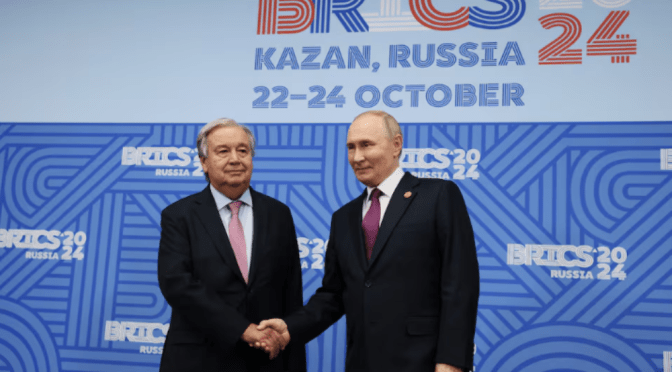
The debate surrounding UN Secretary-General Antonio Guterres’s 22-24 October attendance at the 2024 BRICS summit—that took place in Kazan, Russia—reveals deep fractures in how international diplomacy is understood and practiced in an increasingly polarised world. On one side, critics argue that Guterres’s cordial engagement with Vladimir Putin is tantamount to endorsing his actions. They assert that such diplomacy undermines the moral authority of the UN, especially in light of ongoing conflicts such as the war in Ukraine.

Alexander J. Motyl, a professor of political science at Rutgers University-Newark, in his article published on The Hill criticizes the Secretary-General for meeting a “war criminal” at the summit. He argues that while Guterres has a duty to engage with world leaders, it is morally wrong for him to appear cordial with dictators like Putin. These actions endorse Putin’s war and diminish the UN’s credibility, particularly at a time when tensions are escalating due to North Korean troops arriving in Russia to support the war in Ukraine.

Should leaders in times of escalating conflict take clear stances that reflect their commitment to justice and accountability? Bahauddin Foizee frames Guterres’s approach as a necessary engagement for peace. His role is not merely to condemn aggression but to foster dialogue among all nations, even those accused of serious crimes.

Sidelining Russia, says Foizee, could jeopardise the UN’s broader mission and limit opportunities for conflict resolution. His perspective highlights the complexity of international relations, where rigid moral absolutism can hinder the nuanced diplomacy required to achieve lasting peace. Foizee also defends Guterres’s absence from Ukraine’s peace summit in Switzerland in June on accord of the need for balance; attending would have necessitated alignment with Western proposals, potentially alienating Russia.

Ihor Petrenko, a Ukraine-based journalist who works as a fixer for foreign media, has been vocal in criticizing Guterres for his meet and greet with Putin. Petrenko argues that Guterres’s decision to meet with Putin, despite the Russian leader being an International Criminal Court fugitive, undermines the credibility of the UN and weakens Ukraine’s position in its struggle for sovereignty. Guterres’s calls for a “just peace” in Ukraine, framed within the principles of the UN Charter, are seen by Petrenko and many in Ukraine as hollow and ineffective, especially given the lack of concrete action from the UN to hold Russia accountable for its aggression.

Petrenko highlights the absurdity of Putin dismissing the war as a “family quarrel” during the summit, a remark that Guterres failed to adequately challenge. Furthermore, like Motyl and Foizee, Petrenko too has drawn a comparison between Guterres’s absence from the Switzerland summit and his acceptance of Putin’s invitation to Kazan, pointing out a troubling bias that harms the UN’s reputation. The Ukraine-based journalist criticizes Guterres for aligning with the very powers that perpetuate the war, arguing, like Motyl, that his actions not only diminish the UN’s moral authority but also contribute to the prolongation of the conflict.

Lithuanian leaders, taking a similar view to Motyl and contrasting to that of Foizee, have sharply criticized Guterres for his meeting with Putin and Belarusian leader Alexander Lukashenko at the summit. Lithuania’s Prime Minister Ingrida Šimonytė and Foreign Minister Gabrielius Landsbergis argue that Guterres’s actions undermine his credibility as an impartial mediator, and,going further, accuse him of moral inconsistency, highlighting his failure to attend a peace summit in Switzerland while choosing to engage with Putin. This, they contend, casts doubt on Guterres’s integrity and role as a genuine advocate for peace, leading Lithuania to call for him to take responsibility for his conduct and, if necessary, step down. The Lithuanian critique reflects growing frustration with Guterres’ perceived lack of principled leadership amid the ongoing war in Ukraine.

These contrasting views underscore a pivotal tension in contemporary global politics: the balance between moral leadership and pragmatic diplomacy. Critics of Guterres fear that engaging with dictators could normalise their actions and erode the UN’s credibility. However, proponents assert that without dialogue, the potential for de-escalation and understanding diminishes.

This dilemma raises critical questions about the role of international organisations in addressing conflict: Is the UN a moral arbiter, or should it prioritise dialogue, even with those who perpetrate violence?

It appears that Guterres’s actions will continue to be scrutinised, reflecting broader anxieties about how the international community navigates the turbulent waters of diplomacy in a world rife with injustice. As the war in Ukraine continues and other global tensions simmer, the challenge for Guterres and his successors will be to find pathways to peace without compromising their moral principles. The effectiveness of the UN, and indeed of global diplomacy itself, may hinge on this delicate balance.

This article was first published on Australian Outlook, a publication of the Australian Institute of International Affairs (AIIA) under a Creative Commons Licence and may be republished with attribution.


Daniel Raynolds writes opinions and reviews about various topics, including human rights violations across the world. He has been published, among others, on The New Federalist, Foreign Policy News, Eurasia Review, International Policy Digest, GAC European Union Politics, Washington Politics Blog, OnLine Opinion (Australia).


Putin’s Plan Failing in Ukraine


By Nicholas Lovric


The biggest war in Europe since the World War Two (WWII) was launched by the Russian President Vladimir Putin with the excuse that Ukraine was leaning too much towards the West so much so that it became a constant threat for Russia to feel safe, develop and exist. With this war on the Ukrainians, Putin created the biggest post-WWII security crisis in the continent.

During the launch of invasion of Ukraine in late February, Putin declared he had several goals; one being to “demilitarize and de-Nazify Ukraine”. However, an opinion piece published on Ria Novosti, a Russian state-run news agency, made clear that “de-nazification is inevitably also de-Ukrainization”, meaning the aim was to erase the modern Ukrainian state.

Putin’s another self-declared goal of the invasion was to protect civilians in Ukraine’s eastern regions, areas which have borders with Russia and which are home to Russia-backed separatist groups. He said he wanted to protect the people who were subjected to what he called eight years of bullying and genocide by Ukraine’s government, though there was no evidence they were under any threat. Instead, it is Russia that is now accused by the international community of carrying out war crimes and some countries even called Russia’s actions in Ukraine a genocide.

Putin’s another self-declared goal of the invasion was to ensure Ukraine’s neutral status. He wanted to capture Kyiv, kill the Ukrainian government officials and install a pro-Russian government headed by a pro-Russian puppet until the appropriate environment is created for annexing Ukraine with Russia. Indeed, Volodymyr Zelensky, Ukraine’s democratically elected president, said that Russia had designated him as the number one target and his family as target number two. There were accusations that Russian troops made two attempts to storm the presidential compound.

Putin had done all these so that Ukraine and other European neighbours of Russia abandon their desire to join the Western defensive alliance NATO and the multilateral European Union. However, faced with fierce resistance from the Ukrainian military and the civilian-turned-militias, Putin abandoned his bid to capture the capital Kyiv and turned his ambitions to Ukraine’s east and south.

Indeed the weakening morale of the Russian troops inside Ukraine as well as the defeats and stalemates pushed Russia to pull back from Kyiv a month after launch of invasion and declared its main goal was the “liberation of Donbas”, broadly referring to Ukraine’s eastern regions of Luhansk and Donetsk. More than a third of this area was already seized by Russian proxy forces in a war that began in 2014, now Russia wants to conquer all of it.

The Kremlin claimed that the invasion’s first phase had been accomplished by reducing Ukraine’s combat potential. But the reality is that Ukraine’s resistance coupled with pressure of international sanctions and isolation had forced Putin to scale back his ambitions.

With this invasion, Putin’s initial plan was to send a message across Russia’s European neighbourhood that Russia’s neighbours should neither join NATO nor the European Union; otherwise they would face similar fate to that of Ukraine’s, which Putin initially thought would be the fall of Kyiv and gradual disintegration of the country followed by accession to Russia.

However, The Russian troops’ pull back from Kyiv sent a contrary message to Russia’s neighbour that if Putin faces harsh resistance from the enemy, he would decide to settle for less. Indeed, he had settled for endeavoring to take Luhansk and Donetsk, dropping the decision to take the entire Ukraine including the capital Kyiv.

This whole drama was sharply noticed in the capitals of Finland and Sweden, two of Russia’s neighbours, and both capitals perhaps had understood that ‘things did not go Putin’s way’ because Putin fumbled due to harsh resistance. Hence, these two countries have started looking closely at joining NATO, an alliance that now seems as unified as ever.

At the NATO Youth Summit 2022, the NATO Secretary General Jens Stoltenberg said that Finland’s and Sweden’s change of mind regarding joining NATO demonstrates to Putin that he got exactly the opposite of what he wanted; that he wanted less NATO at Russia’s borders but he now got more of it. Jens Stoltenberg blamed Russia’s aggressive actions and threatening rhetoric for driving many nations in Europe to opt for NATO membership.

Indeed, Putin triggered the opposite effect of what he wanted out of the Ukraine invasion. He wanted to weaken NATO; instead he unintentionally helped NATO to become much stronger now. What an unintended consequence of war!

This article was originally published on Oped Column Syndication.


Nicholas Lovric is a researcher and consultant specializing in Russian and Eastern European affairs. His work typically involves analyzing political, economic and social trends in the region. His expertise spans subjects such as international relations, geopolitical dynamics, security issues and regional development.


Ukraine: Recent Election and EU Membership

Ukrainian leaders are using the goal of EU membership as the spur to get their voters to accept uncomfortable reforms.

[John Bruton | Oped Column Syndication]


The desire for free and fair elections, through which politicians can be held to account, is widespread in the former Communist world.  We have seen this with the arrest in Moscow of over 1000 people, demonstrating against the arbitrary disqualification of candidates for local elections in the city of Moscow, including of a candidate who won 27% of the vote in the last  election.

Corrupting elections was part of the armoury of the Soviet state, and it is a habit that has persisted, long after Communism itself has fallen .

After the more hopeful Yeltsin years, Russia, the biggest Republic of the former Soviet Union, is reverting to Soviet electoral habits. But the second biggest former Soviet Republic, Ukraine, is taking a  very different course.

Recent free and fair elections in Ukraine are undoubtedly being watched closely by opposition figures in Russia.

If Ukraine can make a successful democratic transition, it becomes harder for President Putin to argue that Russia must retain a more authoritarian system. Another neighbour of Ukraine, Viktor Orban of Hungary, will also have to take note.

I have recently had the opportunity of spending a week in Ukraine, as one of a large number of international observers of their Parliamentary Election on 21 July.

The consensus among observers was that these Elections, called early by the newly elected President Zelensky, were both free and fair.

Votes  in Ukraine are cast in secret, and when the polls close, are counted openly, in the local polling stations themselves. From my observation, these tasks were carried out conscientiously and transparently.

This is not to say that Ukrainian democracy is free of problems.

On a per capita basis , Ukraine is the poorest country in Europe. Even Moldova is slightly better off. The country’s growth rate is well below potential.

The country is at war, a war that has cost 13000 lives so far. In response to Russian armed interference, Ukraine has had to develop a large army of its own, almost from scratch.

Yet it depends for income, on transit fees for Russian gas, being piped through Ukraine to customers in the EU. Its  public finances are not in good order, it has had to get help from the IMF, and has had to increase fuel prices to its own citizens as part of the IMF programme.

Like many former Communist states, including ones already in the EU, it suffers from endemic corruption.

Fighting corruption is one of the goals of the new President. He is handicapped in this effort by the lack of a professional non political civil service, and  of an independent, properly resourced, courts system. These deficiencies inhibit foreign direct investment, because investors need to know honest and efficient courts will be there to protect their legal rights, before they put their money at risk

MPs are immune from legal proceedings while serving as MPs, and this privilege has attracted some people into politics in pursuit of their private interests, rather than the public good. The President has promised to end this immunity, but he has got to get the MPs to vote for this.

While the election itself was free and fair, the television coverage of the campaign was not. Ukrainians rely heavily on television to inform themselves about politics. Television stations tend to be controlled by rival oligarchs, and these oligarchs often are politicians in their own right. Rules requiring balanced coverage during election campaigns are not properly enforced.

Ukraine has an Association Agreement with the EU, which is described as “the most ambitious the EU has with any non EU member state”. Indeed this agreement may serve as a model for a future UK Agreement with the EU, whenever the tortuous Brexit process in concluded.

But there are clear signs that Ukrainians will not be satisfied , in the long run, with a mere Association Agreement with the EU, however ambitious it may be. Their goal is to be a full voting member state of the EU.  When they signed the EU Association Agreement, they rejected President Putin’s offer to join his proposed Eurasian Union. Indeed it was that rejection that triggered the Russian invasion of Crimea and of parts of eastern Ukraine. So, Ukraine has paid a high price for its EU choice.

It also is a very big country, with over 40 million people.

It may have been a privileged “vassal”, or first daughter, of the Russian Empire in the past. But it has decided to turn its back on  that and has set itself the goal of joining the EU instead, and not in a secondary role. Its leaders are using the goal of EU membership as the spur to get their voters to accept uncomfortable reforms.

But the prospect, however long term, of EU membership for Ukraine is far from simple for the EU.

In 2001, the EU enlarged itself very quickly and took in many new member states in central and eastern Europe. Some of these countries had unresolved  post Communist problems of the kind still besetting Ukraine…corruption, weak courts, poor public administration, organised crime and oligarchical control of the media.

The EU is, in its essence, a set of uniform rules, on the basis of which its citizens enjoy freedoms across a whole continent. But, if the enforcement of these rules can be corrupted through weak or politicised courts or by bad administration, these EU wide freedoms cease to mean anything.

So until the EU is satisfied it has got on top of  the corruption and rule of law problems it already has among  some of its own existing members, like Hungary, Poland, Romania and Bulgaria, it will be very  slow in admitting new members, like Ukraine, where the same problems are unresolved.

The EU is in a stronger position to insist of high standards in a country, like Ukraine, which is still looking for membership. It is harder to insist with countries that are already full voting members of the club.  Existing members can and will used their votes in the Council of Ministers to block EU sanctions for rule of law, or related, breaches of EU standards.

Getting these rule of law issues right will be the number one priority of the new Von der Leyen Commission, even ahead of Brexit.

Until it does that, the EU cannot credibly offer hope of membership to countries like Ukraine, Northern Macedonia and Albania. Without such hope, these countries could turn away from the EU,  and other global players, such as China, Turkey or Russia, could take the EU’s place.


John Bruton is the former Prime Minister of the Republic of Ireland  (1994-97) and the former European Union Ambassador to the United States (2004-09). He has held several important offices in Irish government, including Minister for Finance, Minister for Industry & Energy, and Minister for Trade, Commerce & Tourism.


Inside Putin’s Head

Vladimir Putin tries to legitimize his disregard of the ‘rule of law’ by claiming that all former territories dating back to the Byzantine Era and native Russian speakers must be protected by “Mother Russia”. However, the reality is: these territories give Russia access to warm water ports necessary to ship its oil and weapons.

[Cynthia M. Lardner | Oped Column Syndication]


Russian Federation President Vladimir Putin’s approach to foreign relations and military engagement is opportunistic, aggressive and expansionist. These traits – the anti-thesis of multilateralism and cooperation – are driven by Putin’s mental schema that he has been called upon to defend everyone of Russian descent.

Putin’s actions over the last decade, especially in Ukraine, the Crimean Peninsula, Georgia, South Ossetia and Abkhazia, have cost him his G8 seat and open dialogue with NATO and other foreign powers, to the point where many consider this a resurgence of the Cold War. Since 2015 Russia has been slapped with an increasing number of Western sanctions. The Russian plutocracy remains largely unscathed due to their inter-relationship with the Russian government. Then there is Russia’s vast oil reserves upon which the European Union and other countries are heavily dependent.

Furthermore, more than $250 billion in goods and services exchanged annually between Russia and its largest trading partner, i.e. Western Europe. Russia is also non-discriminatory in its sale of weapons and military technology to foreign powers, including Iran and North Korea. It’s the Russian people, living under Putin’s authoritarian rule, who have, undoubtedly, been forced to endure the adverse economic impact caused by the rapid decline of the ruble.

Russia is one of the five permanent members of the United Nations Security Council, and each of these members has veto power, extending to the enforcement of all international tribunal decisions and, if necessary to dispatch peacekeeping missions. Thus, the Russian Federation is protected from international judicial civil accountability in the International Court of Justice or the Permanent Court of Arbitration, which hears cases between United Nations member nations.

As Russia is not a party to the Rome Statue, it is not subject to criminal liability before the International Criminal Court. By way of example, assuming, arguendo, that there was a viable enforcement mechanism, Russia could have been held responsible for the illegal annexation of Crimea under the Minsk II Agreement, and for its actions in Syria. In sum, Putin rules the Russia with impunity and without accountability.

Gorbachev and Kissinger Speak Out

Mikhail Gorbachev, the last General Secretary of the Communist Party of the Union of Soviet Socialist Republics (USSR), received a Nobel Peace Prize in 1990 for summits held with Presidents Ronald Reagan and George H.W. Bush resulting in the 1987 Intermediate-range Nuclear Forces (INF) Treaty. The summits were instrumental in bringing the post-World War II Cold War to its conclusion.

The goodwill generated by Gorbachev and his successor Boris Yeltsin, the first president of the newly created Russian Federation, dissipated when Yeltsin resigned as president, appointing Vladimir Putin the acting president until official elections were held in early 2000. He has been re-elected three consecutive times. Based on his interference with any contender posing an actual threat, Putin could hold the presidency indefinitely.

When the Cold War ended Russia expected to be accepted by the West. This never fully materialized. Putin views that Russia has been left disconnected from post-World War II Europe and threatened by the continuation of NATO.

Dialogue between the West and Russia has deteriorated to the point where it is once again in Cold War mode. Many, including NATO Secretary General, Jens Stoltenberg, and Gorbachev have warned that the continued isolation of Russia could lead to armed conflict on European soil.

Gorbachev warned:

The situation hasn’t been this bad in a long time, and I am very disappointed in how world leaders are behaving themselves. We see evidence of an inability to use diplomatic mechanisms. International politics has turned into exchanges of accusations, sanctions, and even military strikes… I am sure no one wants war, but in the current febrile atmosphere could lead to great trouble, and ordinary people are not yet aware of the threat hanging over them…

Legendary former US Secretary of State Henry Kissinger, who has been in contact with both US President Donald Trump and Russian President Vladimir Putin, and Gorbachev agree that, minimally, a détente [easing of hostility] is needed to ease the tensions between the two countries, which would simultaneously ease tensions around the world.

A logical starting place for dialogue would have been to discuss the mutual charges of violations have placed the INF Treaty in jeopardy and the renewal of the 2010 New Strategic Arms Reduction Treaty put bounds on the US-Russian nuclear competition, is due to expire in less than three years. These treaties provide desirable Mutual Assured Stability between the two countries. But the vision most of the world was left with was Putin tossing a soccer ball to Trump.

After the July Helsinki summit between Putin and Trump, Kissinger sadly concluded, “I think we are in a very, very grave period for the world.”

Chicken or the Egg: The Sanctions Conundrum

Since assuming power, Putin has proven himself to be an antagonist. There are several factors driving Putin’s aggressive, opportunistic and expansionist tactics.

Putin believes himself to be irrevocably tied to Europe dating all the way back to the Byzantine Era. Putin has justified his actions by repeatedly stating that it is his duty to protect all the people of Russian descent even if they reside outside of Russia.

While Russia was sanctioned for the Russo-Georgian War, those sanctions do not compare to the sanctions imposed innumerable times by the EU and the US since 2015. The first set of these sanctions were imposed for the 2014 illegal annexation of the Crimean Peninsula for Ukraine. Russia then lost its seat on the G8. It was the illegal annexation and continued occupation of Crimea that initially left Russia diplomatically out in the cold. While the Minsk Protocols were violated, the reality is that Russia is going to continue occupying Crimea in order to access the warm water port [in Sevastopol] in order to transport its oil [through Black Sea]. This creates a diplomatic conundrum for those wise enough to advocate that the current Cold War be transformed into a détente.

More recently, Russia has been sanctioned for tampering with the 2016 US Presidential election and for being found culpable for a chemical weapons attack in Great Britain on a former KGB agent and his daughter. In the eighteen months, Russia has seen diplomats expelled from several countries – most recently in Greece – for a variety of reasons.

Russian Foreign Minister Sergei Lavrov has alleged that Russia – despite the sanctions – has increased its economic and military capacities. The value of the ruble, however, tells a different story. After years of sanctions, the ruble has only slightly recovered.

Sanctions have not proven effective. In the case of the Crimean Peninsula, the sanctions will continue indefinitely despite their ineffectiveness in achieving anything other than increasing Russian ire [anger].

Crisis Group’s senior analyst for Russia, Anna Arutunyan, advocates for a more common sense approach to the imposition of future sanctions:

Rather than creating incentives for changes in Russian policy or behaviour, such sanctions instead serve to reinforce the Kremlin’s narrative that the West will besiege Russia whatever it does. To work more effectively, any fresh Western sanctions should target specific actions – if necessary piece by piece – rather than conflating all of the Kremlin’s aggressive activities abroad. Western powers should lay out clearly what would need to happen for those sanctions to be lifted.

Weakening Democratic Nations

Putin wants to see Western democratic nations weakened. Due to historical ties, that desire to disrupt is greater where the European Union is concerned.

The July summit with Trump made an international mockery of democracy and the ‘rule of law’, and further damaged the US’s relationships with traditional allies. The preceding G7 and NATO summits and meeting with British Prime Minister Theresa May were coups for Putin as they evidenced a weakening amongst Western allies.

A weakening of the ties between democratic nations generates confusion and diminishes the power of the strongest leaders, such as German Chancellor Angela Merkel and French President Emmanuel Macron. Insecurity is increased by the inconsistencies between Trump and senior US military officials.

What’s more, the threat perceived by the Baltics, the Scandinavia, the Balkans, Poland, Ukraine and Georgia has reached an unacceptable level.

Ukraine and Georgia

Along with the well-known ongoing armed conflict in Ukraine’s Donbas region (where Russian troops and mercenaries push for control of even more landmass), there was and is a similar – but lesser known – scenario playing itself out in Georgia.

The trigger was the 2008 NATO Summit, where Georgia and Ukraine were given a commitment that at a future date they would accede to the NATO member-state status. Putin is speculated to believe that his engaging aggressive and expansionist tactics in both Georgia and Ukraine would slow down or even halt the accession process.

Georgia, once a part of the USSR, is wedged between the Middle East, Russia, Iran and Turkey and is an important corridor for oil pumped from the Caspian Sea. This month is the 10th anniversary of the start of the Russo-Georgian War in which Russia drove Georgian troops out of two breakaway provinces, South Ossetia and Abkhazia. To date, the Kremlin continues to illegally occupy these territories going so far as so construct nineteen military bases in South Ossetia alone.

Georgia is still being attacked by militants using covert tactics that, until recently, were ignored by the media. Pro-Russian militants are taking back Georgia hectare by hectare under cover of darkness, saving Russia from the burden of engaging in an all-out [direct] armed conflict with Georgia. There are times when Georgian farmers wake up only to discover warning signs, barbed wire and even surveillance cameras on what was only the day before part of their farms.

Based on his ill-conceived belief predating the USSR, Putin tries to legitimize his disregard of the ‘rule of law’ by claiming that all former territories dating back to the Byzantine Era and native Russian speakers must be protected by “Mother Russia”, including Georgia, especially South Ossetia, and the Crimean Peninsula. However, the reality is: these territories give Russia access to warm water ports necessary to ship its oil and, no doubt, weapons.

Admiral James Foggo, Commander of US Naval Forces Europe and Africa, stated that Russia is deploying more submarines to the Mediterranean, Black Sea and North Atlantic at the highest rate since the end Cold War.

At the 2018 NATO Summit, the alliance’s member-states reaffirmed their commitment to Georgia that it will accede to NATO member-state status. Putin responded with the expected threat that if NATO added Georgia on Russia’s southern flank, it would “respond appropriately to such aggressive steps which pose a direct threat to Russia.”

The Baltics, Poland and Scandinavia

Then there’s the threat to the EU’s north — specifically Poland, Latvia, Estonia and Lithuania.

The Soviet Union seized Lithuania in 1939. On March 11, 1990, Lithuania declared that it was an independent state, the first of the Soviet republics to do so. While Poland was not a Soviet satellite state, it was under Soviet and, then, Russian control until 1989.

At present, [Russia’s] neighboring countries, Finland and, to a lesser degree, Sweden and Norway have a heightened sense of fear of Putin’s tactics. The Lithuanian and Swedish governments have gone so far as to disseminate materials to their citizens about how to spot a Kremlin agent and what to do in the event of an attack.

Finland was under Russian control until 1917 and the two countries share an 833 mile border. For over 100 years, Finland has tread a fine between Europe and Russia. An EU member since 1995, Finland is not a NATO member. However, Finland participates in nearly all sub-areas of the Partnership for Peace programme and has provided peacekeeping forces to the NATO missions in Afghanistan and Kosovo.

But, it is Poland and Lithuania that face the biggest threat due to the strategic location of the Suwalki Gap, a narrow 64 mile piece of land connecting NATO member-states Poland and Lithuania. Occupation of the Suwalki Gap or bordering Lithuanian territory by Russia would cut off the three Baltic States from other NATO countries. The US Army Europe commander Lieutenant General Ben Hodges stated that the Suwalki Gap is a high potential Russian military target.

Analysts have compared Suwalki Gap to the Cold War era’s German Fulda Gap, where NATO planned and prepared for hypothetical USSR attacks.

NATO has enhanced its forward military presence in more than five regions.

NATO has also created new five cyber warfare centers in Finland, Estonia, Poland, Germany and France.

At a time when NATO needs to rely on Poland, it has boldly challenged adherence to the ‘rule of law’. In January, Poland passed a bill criminalizing any suggestion Poland was complicit in the Holocaust, resulting in sharp criticism by the EU and the US. In July, Poland pulled away from the EU when it changed its judicial system in violation of the rules set by the EU. These are odd tactics for a country that is fearful of Russia. It is questionable what impact Russian operatives supporting far-right nationalists have had on recent events in Poland.

There’s [Russian] Western Military Command for countering NATO. Headquartered in St. Petersburg, the Western Military Command covers 26 federal subjects (including Moscow and Kaliningrad), bordering Poland, the Baltic States, Finland and Norway. A May 2018 Rand Corp report described it as “Russia’s most-capable ground and air forces”.

Strengthening Russia as an independent international player does not give rest to our NATO colleagues. They are trying in every possible way to prevent Russia from becoming a geopolitical competitor, all the more having allies,” stated Russian Defense Minister Sergei Shoigu.

Not only have Russia’s actions and capabilities increased in alarming and confrontational ways, its national-security policy is aimed at challenging the US and its NATO allies and partners,” said Admiral Foggo.

Putin has heightened the threat level by engaging leaders from those European states which are either not part of the EU or were former USSR satellite states, and also by engaging voters who feel disenfranchised from the EU or the US. Additionally, Putin controls a vast propaganda machine and a host of cyber-warfare tactics that has interfered with numerous elections, most notably in the US, France, Austria and Germany, as well as inciting anti-democratic and even white supremacist protests.

Russia has used soft power to deter former Soviet republics and states to Russia’s west and south from joining NATO and the EU. Putin’s authoritarian leadership is admired by Czech Republic President Miloš Zeman, Hungary Prime Minister Viktor Orbán and Serbian Prime Minister Alexander Vucic.


Cynthia M. Lardner is an American journalist residing in the Netherlands and is a contributing editor to Tuck Magazine and the International Policy Digest. Ms. Lardner holds degrees in journalism, law, and counseling psychology.