Tag Archives: Afro-Eurasia

Ukraine: Recent Election and EU Membership

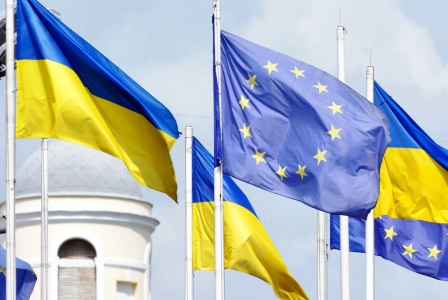
Ukrainian leaders are using the goal of EU membership as the spur to get their voters to accept uncomfortable reforms.

[John Bruton | Oped Column Syndication]


The desire for free and fair elections, through which politicians can be held to account, is widespread in the former Communist world.  We have seen this with the arrest in Moscow of over 1000 people, demonstrating against the arbitrary disqualification of candidates for local elections in the city of Moscow, including of a candidate who won 27% of the vote in the last  election.

Corrupting elections was part of the armoury of the Soviet state, and it is a habit that has persisted, long after Communism itself has fallen .

After the more hopeful Yeltsin years, Russia, the biggest Republic of the former Soviet Union, is reverting to Soviet electoral habits. But the second biggest former Soviet Republic, Ukraine, is taking a  very different course.

Recent free and fair elections in Ukraine are undoubtedly being watched closely by opposition figures in Russia.

If Ukraine can make a successful democratic transition, it becomes harder for President Putin to argue that Russia must retain a more authoritarian system. Another neighbour of Ukraine, Viktor Orban of Hungary, will also have to take note.

I have recently had the opportunity of spending a week in Ukraine, as one of a large number of international observers of their Parliamentary Election on 21 July.

The consensus among observers was that these Elections, called early by the newly elected President Zelensky, were both free and fair.

Votes  in Ukraine are cast in secret, and when the polls close, are counted openly, in the local polling stations themselves. From my observation, these tasks were carried out conscientiously and transparently.

This is not to say that Ukrainian democracy is free of problems.

On a per capita basis , Ukraine is the poorest country in Europe. Even Moldova is slightly better off. The country’s growth rate is well below potential.

The country is at war, a war that has cost 13000 lives so far. In response to Russian armed interference, Ukraine has had to develop a large army of its own, almost from scratch.

Yet it depends for income, on transit fees for Russian gas, being piped through Ukraine to customers in the EU. Its  public finances are not in good order, it has had to get help from the IMF, and has had to increase fuel prices to its own citizens as part of the IMF programme.

Like many former Communist states, including ones already in the EU, it suffers from endemic corruption.

Fighting corruption is one of the goals of the new President. He is handicapped in this effort by the lack of a professional non political civil service, and  of an independent, properly resourced, courts system. These deficiencies inhibit foreign direct investment, because investors need to know honest and efficient courts will be there to protect their legal rights, before they put their money at risk

MPs are immune from legal proceedings while serving as MPs, and this privilege has attracted some people into politics in pursuit of their private interests, rather than the public good. The President has promised to end this immunity, but he has got to get the MPs to vote for this.

While the election itself was free and fair, the television coverage of the campaign was not. Ukrainians rely heavily on television to inform themselves about politics. Television stations tend to be controlled by rival oligarchs, and these oligarchs often are politicians in their own right. Rules requiring balanced coverage during election campaigns are not properly enforced.

Ukraine has an Association Agreement with the EU, which is described as “the most ambitious the EU has with any non EU member state”. Indeed this agreement may serve as a model for a future UK Agreement with the EU, whenever the tortuous Brexit process in concluded.

But there are clear signs that Ukrainians will not be satisfied , in the long run, with a mere Association Agreement with the EU, however ambitious it may be. Their goal is to be a full voting member state of the EU.  When they signed the EU Association Agreement, they rejected President Putin’s offer to join his proposed Eurasian Union. Indeed it was that rejection that triggered the Russian invasion of Crimea and of parts of eastern Ukraine. So, Ukraine has paid a high price for its EU choice.

It also is a very big country, with over 40 million people.

It may have been a privileged “vassal”, or first daughter, of the Russian Empire in the past. But it has decided to turn its back on  that and has set itself the goal of joining the EU instead, and not in a secondary role. Its leaders are using the goal of EU membership as the spur to get their voters to accept uncomfortable reforms.

But the prospect, however long term, of EU membership for Ukraine is far from simple for the EU.

In 2001, the EU enlarged itself very quickly and took in many new member states in central and eastern Europe. Some of these countries had unresolved  post Communist problems of the kind still besetting Ukraine…corruption, weak courts, poor public administration, organised crime and oligarchical control of the media.

The EU is, in its essence, a set of uniform rules, on the basis of which its citizens enjoy freedoms across a whole continent. But, if the enforcement of these rules can be corrupted through weak or politicised courts or by bad administration, these EU wide freedoms cease to mean anything.

So until the EU is satisfied it has got on top of  the corruption and rule of law problems it already has among  some of its own existing members, like Hungary, Poland, Romania and Bulgaria, it will be very  slow in admitting new members, like Ukraine, where the same problems are unresolved.

The EU is in a stronger position to insist of high standards in a country, like Ukraine, which is still looking for membership. It is harder to insist with countries that are already full voting members of the club.  Existing members can and will used their votes in the Council of Ministers to block EU sanctions for rule of law, or related, breaches of EU standards.

Getting these rule of law issues right will be the number one priority of the new Von der Leyen Commission, even ahead of Brexit.

Until it does that, the EU cannot credibly offer hope of membership to countries like Ukraine, Northern Macedonia and Albania. Without such hope, these countries could turn away from the EU,  and other global players, such as China, Turkey or Russia, could take the EU’s place.


John Bruton is the former Prime Minister of the Republic of Ireland  (1994-97) and the former European Union Ambassador to the United States (2004-09). He has held several important offices in Irish government, including Minister for Finance, Minister for Industry & Energy, and Minister for Trade, Commerce & Tourism.


The Spanish Labyrinth

Newly minted Prime Minister Pedro Sanchez faces at least two daunting tasks: cleaning up the wreckage wrought by enforced austerity and resolving the Catalan crisis after last fall’s independence referendum.

[Conn M. HallinanOped Column Magazine]


As the socialist-led government takes over in Spain, newly minted Prime Minister Pedro Sanchez faces at least two daunting tasks: cleaning up the wreckage wrought by years of European Union (EU) enforced austerity and resolving the Catalan crisis exacerbated by Madrid’s violent reaction to last fall’s independence referendum. Unfortunately, his Party’s track record is not exactly sterling on either issue.

Sanchez, leader of the Socialist Workers Party (PSOE), patched together parties in Catalonia and the Basque region, plus the leftist Podemos Party, to oust long-time Prime Minister Mariano Rajoy of the People’s Party (PP). But is the telegenic former economics professor up to the job, and will his Party challenge the economic program of the EU’s powerful “troika”—the International Monetary Fund, the European Central Bank and the European Commission?

The answers to those questions are hardly clear, and in many ways the cross currents and rip tides of Spanish politics still resemble Gerald Brenan’s classic study of the Civil War, The Spanish Labyrinth.

While the issue that brought Rajoy down was corruption—a massive kickback scheme that enriched scores of high-ranking PP members— his Party was already weakened by the 2015 election, and he has been forced to rely on the conservative Ciudadanos Party based in Catalonia to stay in power. In short, it was only a matter of time before he fell.

Sanchez promises to address the “pressing social needs” of Spaniards, although he has been vague about what that actually means. But Spain is hurting. While economic growth returned in 2013, unemployment is still at 16.1, and youth joblessness is 35 percent. Rajoy took credit for the economy’s rebound from the massive financial meltdown in 2008, but there is little evidence that budget cuts and austerity did the trick. The two main engines for growth were cheap oil and a weak currency.

The job growth has mainly been in short-term and temporary jobs, with lower pay and fewer benefits. That is not specific to Spain, however. Of the 5.2 million jobs created in the EU between 2013 and 2016, some 2.1 million of them have been short term, “mini” jobs that have been particularly hard on young people. Many continue to live at home with their aging parents, and 400,000 have emigrated to other European countries.

Education, health care, and infrastructure have all deteriorated under a blizzard of budget cuts, and Sanchez will have to address those problems. His party’s record on the economy, however, has been more centrist than social democratic, and the PSOE basically accepts the neo-liberal mantra of tax cuts, deregulation and privatization. It was PSOE Prime Minister Jose Zapatero who sliced more than $17 billion from the budget in 2010, froze pensions, cut child care funds and home care for the elderly, and passed legislation making it easier to lay off workers.

It was anger at the Socialists over rising unemployment that swept Rajoy and the PP into power in 2011. The PSOE has never recovered from that debacle, dropping from 44 percent of the vote to 24.9 percent today. It has only 84 deputies in the Parliament, just 14 more than Podemos.

When Podemos leader Pablo Iglesias proposed forming a government of the left. Sanchez rejected it and instead appointed all PSOE people to the cabinet. However, he will have to rely on support from the left to stay in power, and there is no guarantee that it will be there unless the Socialists step away from their centrism and begin rolling back the austerity measures.

Sanchez has a mixed record on leftism vs. centrism. He was ousted from the Party’s leadership last year by the PSOE’s rightwing when he considered forming a united front of the left. It was the Party’s rank and file, angered at the rightwing Socialists that allowed Rajoy to form a minority government that put him back in power. So far, Sanchez has been unwilling to consider the kind of alliance of left parties that has been so successful in Portugal.

The new government will also need the support of the two Catalan parties, and that will likely be an uphill slog. The Catalans just elected a government that supports independence, although its President, Quim Torra has called for “talks.”

The current Catalonia crisis was ignited when Rajoy torpedoed a 2006 agreement between the Spanish government and the Catalan government that would have given the province greater local control over its finances and recognized the Catalan’s unique culture. Under the prodding of the PP, the Constitutional Court overturned the agreement and shifted the dispute from the political realm to a legal issue.

At the time, the idea of independence was marginal in Catalonia, but the refusal of Rajoy to even discuss the issue shifted it to the mainstream. “Independentism, which until 2010 was a decidedly minority option in Catalonia, has grown immensely,” according to Thomas Harrington, a Professor of Hispanic Studies at Trinity College, CT.

The Catalans began pressing for a referendum on independence—nearly 80 percent supported holding one—although it was initially seen as non-binding. Even though Podemos did not support the idea of independence, it backed the basic democratic right of the Catalans to vote on the issue. The PSOE, however, was as hard-nosed on the issue as Rajoy and the PP. Not only did the Socialists not support the right of the Catalans to vote, they backed Rajoy’s crackdown on the province, although they decried the violence unleashed on citizens trying to vote during last October’s referendum.

Some 2.3 million Catalans out of the 5.3 million registered voters went to the polls and overwhelmingly endorsed independence in spite of the fact that Rajoy sent some 10,000 National Police and Guardia Civil into the province to seize ballot, beat voters and injure more than 850 people. Legal procedures have been filed against over 700 mayors and elected officials, and the Catalan leadership is either in jail or on the run. While Sanchez said the crackdown was “a sad day for our democracy,” he will have a lot of explaining to do to the Catalan government.

Unlike Rajoy, Sanchez says he wants a dialogue with the Catalans, although he also says he intends to uphold the Spanish constitution, which does not permit secession.

Catalan society is deeply split. The big cities tend to be opposed to independence, as are many trade unions. The left is divided on the issue, but many young people support it. As the Financial Times’ Tobias Buck points out, “The younger generation, who have been schooled in Catalan and have less contact with the rest of Spain than their parents, are among the most enthusiastic backers of independence.”

It is also clear that the brutality of Rajoy’s assault has moved people in that direction, although polls show independence still does not have a majority. But in a sense, that is irrelevant. When almost half the population wants something that “something” has to be addressed, and if Buck is right about the demographics, time is running out for Madrid.

There are other serious constitutional issues that need to be addressed as well. Rural areas are greatly favored over cities. While it takes 125,000 voters in Madrid to elect a representative, in some rural areas it takes as few as 38,000. There is also a need to address Rajoy’s draconian laws against free speech and assembly.

Just how stable Sanchez’s government will be is unclear. He must keep the Basques and the Catalans on board and do enough on the economy to maintain the support of Podemos.

The PP is badly wounded, and the rightwing Ciudadanos Party—the only one that voted against the no confidence resolution—will be looking to fill that vacuum. Ciudadanos calls itself the “center,” but its economic policies are the same as those of the PP, and it is rabidly opposed to separatism. It performed poorly in the last election and in regional elections in Galicia and the Basque region. It did well in the recent Catalan elections, but that is because the Popular Party collapsed and its voters shifted to Ciudadanos.

Sanchez must recognize that the Catalan issue is political, not legal, and that force is not an option. As Napoleon Bonaparte’s Foreign Minister Talleyrand once remarked, “You can do anything you like with bayonets, except sit on them,” summing up the truism that repression does not work in the long run.


Conn M. Hallinan is a California-based independent journalist. He is a regular columnist for the think tank Foreign Policy In Focus and holds a PhD in Anthropology from the University of California, Berkeley.