Category Archives: Opinion

UN Chief’s Recent Engagement with Putin: Ethical Blunder or Diplomatic Necessity?


By Daniel Raynolds


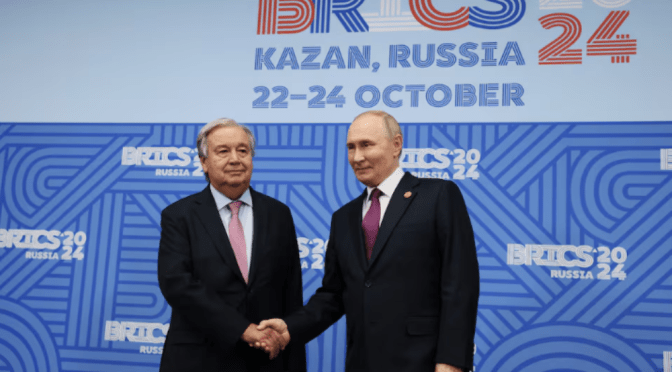
The debate surrounding UN Secretary-General Antonio Guterres’s 22-24 October attendance at the 2024 BRICS summit—that took place in Kazan, Russia—reveals deep fractures in how international diplomacy is understood and practiced in an increasingly polarised world. On one side, critics argue that Guterres’s cordial engagement with Vladimir Putin is tantamount to endorsing his actions. They assert that such diplomacy undermines the moral authority of the UN, especially in light of ongoing conflicts such as the war in Ukraine.

Alexander J. Motyl, a professor of political science at Rutgers University-Newark, in his article published on The Hill criticizes the Secretary-General for meeting a “war criminal” at the summit. He argues that while Guterres has a duty to engage with world leaders, it is morally wrong for him to appear cordial with dictators like Putin. These actions endorse Putin’s war and diminish the UN’s credibility, particularly at a time when tensions are escalating due to North Korean troops arriving in Russia to support the war in Ukraine.

Should leaders in times of escalating conflict take clear stances that reflect their commitment to justice and accountability? Bahauddin Foizee frames Guterres’s approach as a necessary engagement for peace. His role is not merely to condemn aggression but to foster dialogue among all nations, even those accused of serious crimes.

Sidelining Russia, says Foizee, could jeopardise the UN’s broader mission and limit opportunities for conflict resolution. His perspective highlights the complexity of international relations, where rigid moral absolutism can hinder the nuanced diplomacy required to achieve lasting peace. Foizee also defends Guterres’s absence from Ukraine’s peace summit in Switzerland in June on accord of the need for balance; attending would have necessitated alignment with Western proposals, potentially alienating Russia.

Ihor Petrenko, a Ukraine-based journalist who works as a fixer for foreign media, has been vocal in criticizing Guterres for his meet and greet with Putin. Petrenko argues that Guterres’s decision to meet with Putin, despite the Russian leader being an International Criminal Court fugitive, undermines the credibility of the UN and weakens Ukraine’s position in its struggle for sovereignty. Guterres’s calls for a “just peace” in Ukraine, framed within the principles of the UN Charter, are seen by Petrenko and many in Ukraine as hollow and ineffective, especially given the lack of concrete action from the UN to hold Russia accountable for its aggression.

Petrenko highlights the absurdity of Putin dismissing the war as a “family quarrel” during the summit, a remark that Guterres failed to adequately challenge. Furthermore, like Motyl and Foizee, Petrenko too has drawn a comparison between Guterres’s absence from the Switzerland summit and his acceptance of Putin’s invitation to Kazan, pointing out a troubling bias that harms the UN’s reputation. The Ukraine-based journalist criticizes Guterres for aligning with the very powers that perpetuate the war, arguing, like Motyl, that his actions not only diminish the UN’s moral authority but also contribute to the prolongation of the conflict.

Lithuanian leaders, taking a similar view to Motyl and contrasting to that of Foizee, have sharply criticized Guterres for his meeting with Putin and Belarusian leader Alexander Lukashenko at the summit. Lithuania’s Prime Minister Ingrida Šimonytė and Foreign Minister Gabrielius Landsbergis argue that Guterres’s actions undermine his credibility as an impartial mediator, and,going further, accuse him of moral inconsistency, highlighting his failure to attend a peace summit in Switzerland while choosing to engage with Putin. This, they contend, casts doubt on Guterres’s integrity and role as a genuine advocate for peace, leading Lithuania to call for him to take responsibility for his conduct and, if necessary, step down. The Lithuanian critique reflects growing frustration with Guterres’ perceived lack of principled leadership amid the ongoing war in Ukraine.

These contrasting views underscore a pivotal tension in contemporary global politics: the balance between moral leadership and pragmatic diplomacy. Critics of Guterres fear that engaging with dictators could normalise their actions and erode the UN’s credibility. However, proponents assert that without dialogue, the potential for de-escalation and understanding diminishes.

This dilemma raises critical questions about the role of international organisations in addressing conflict: Is the UN a moral arbiter, or should it prioritise dialogue, even with those who perpetrate violence?

It appears that Guterres’s actions will continue to be scrutinised, reflecting broader anxieties about how the international community navigates the turbulent waters of diplomacy in a world rife with injustice. As the war in Ukraine continues and other global tensions simmer, the challenge for Guterres and his successors will be to find pathways to peace without compromising their moral principles. The effectiveness of the UN, and indeed of global diplomacy itself, may hinge on this delicate balance.

This article was first published on Australian Outlook, a publication of the Australian Institute of International Affairs (AIIA) under a Creative Commons Licence and may be republished with attribution.


Daniel Raynolds writes opinions and reviews about various topics, including human rights violations across the world. He has been published, among others, on The New Federalist, Foreign Policy News, Eurasia Review, International Policy Digest, GAC European Union Politics, Washington Politics Blog, OnLine Opinion (Australia).

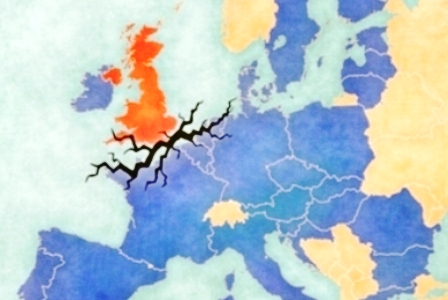
EU Must Not Allow UK to Ditch Provisions of Northern Ireland Protocol


By John Bruton


The UK government is unilaterally signalling its intent to ditch  the provisions of the Northern Ireland Protocol that are designed to protect the integrity of the EU Single Market. The integrity of the Single Market rests on their being a single set of rules, uniformly enforced and consistently applied, across the 27 EU States.  

Under the Protocol, goods produced in [Northern Ireland] would enjoy full access to the Single Market without any checks at the EU border in Ireland or anywhere else. The Protocol also affirms that [Northern Ireland] retains full access to the UK market. This is a win/win situation for [Northern Ireland] business.

The new UK legislation announced this week would instead create a control free zone in Ireland, which would radically weaken Irelands   position as a member of the EU. By doing away with the controls at the ports in [Northern Ireland], envisaged in in the Protocol, it would create a situation whereby good and foods, not meeting EU standards, could be brought into the EU market via Ireland.

We should not forget that the Withdrawal Agreement, of which the Protocol was a central part, was a key element in the winning Conservative Party General Election Manifesto of 2019.

Now the joint author of the Protocol, Boris Johnson , wants eviscerate it by means of unilateral UK legislation.

A unilateral breach of a Treaty by domestic legislation  on an internationally sensitive matter Is clearly a breach of international law.  

International commerce, in which the UK was once a major champion, rests on scrupulous respect for treaties and contracts.

“My word  is my bond” was once a watchword in British international dealings. No more, it seems.

The UK are now claiming that an international Treaty can be breached on the basis of “necessity”.

This is a hard claim to justify in this case. Fifty-two of the 90 members of Northern Ireland Assembly have indicated support for the Protocol, so there is no democratic “necessity“ to scrap the Protocol.

It is true that the DUP has said it will not sit in the [Northern Ireland] Executive unless it’s seven demands for changes are met. These demands are vaguely phrased and symbolic  and do not provide a solid basis for legal resolution. It is not clear when or if the DUP would take up their seats in the [Northern Ireland] Executive. So one  minority political party , in  small part of the UK , cannot be allowed to determine what is a “necessity” for a large and diverse state like the UK .

The fact that the UK government, Parliament, and electorate , all endorsed the Protocol as recently as 2019, with their eyes wide open, makes it very hard to plead “necessity” as a ground for undoing their own work.

An objective court would decide that they could and should have anticipated what would happen in their own jurisdiction.

The situation we are in today is a sign that debate within the ruling Tory party is taking place within a bubble, within which the needs of others outside the bubble are not heard.

Following the debate on the Protocol in Tory supporting press in Britain is like watching the reaction of the Republican base to the hearings about the invasion of the Capitol. They hear what they want to hear , and nothing else.

One Brexiteer recently described the [Northern Ireland] Protocol as “a punishment the EU inflicted on the UK for Brexit”. This is despite the fact that in 2019, Boris Johnson, who negotiated the Protocol himself, claimed that ,in the Protocol , he had swiftly negotiated  what he called a “great new deal”!

He, unlike his predecessor, had got Brexit done, he boasted.

The  same Brexiteer writer said the Protocol was “an attempted power grab” by the EU over the [Northern Ireland] economy “on behalf of its allies in Dublin”. The writer ignores the fact, under rules written while the UK was still an EU member, the Single Market of the EU has to have border controls, and these controls have to be more or less the same at all EU Borders.

Any precedent the EU might cede to the UK will be demanded by other non EU states with land borders with the EU.

The UK demands to be trusted when they say that nothing that fails to meet EU standards will cross the border into the EU .

They seem to have forgotten the long tradition of smuggling on and around the [Northern Ireland] border, some of which which helped finance paramilitary activity in the past, activity which costs thousand of Irish (and British) lives, and  could do so again.

Trust has to be earned, it cannot be commanded. If the EU cannot trust the UK government to keep its word, it will be even harder for it trust the private sector “trusted traders”, the same government appoints to protect the EU from the smuggling of sub standard goods and foods across the border into the Republic.

WHAT WILL HAPPEN NOW?

The EU has made clear the terms of the Agreed Protocol will not be changed. It has also made clear that without the Protocol there could have been no Withdrawal Agreement, and without that, there could have been no Trade and Cooperation Agreement (TCA).

Without the TCA, the Common External Tariff of the EU would have to be applied to British goods coming into Ireland and every other EU state. This would be deeply destructive , but it is the logical outcome , when one tries to unravel complex inter related  international agreements unilaterally. The whole thing comes apart.

As an EU member, Ireland would then have to apply the Common External Tariff on its own land and sea borders, a task of daunting proportions politically and practically. The effect on stability in [Northern Ireland], and the sense of isolation of Northern nationalists, would be intense. The disruption of the food industry in The whole of Ireland would be disastrous.

One hopes that it will not come to that. But pretending that this could never happen is not wise.

The best approach for the EU will be to gradually turn up the heat on the UK so as to give them time to learn that actions have consequences, and the price could be very high. The European Commission has much experience in trade disputes and know how and where to target it’s actions. Meanwhile the political climate in the UK could change. The UK opposition parties need to assert themselves for the sake of the reputation of their country.

This article was originally published on Oped Column Syndication.


John Bruton was the Prime Minister of the Republic of Ireland (1994-97) and the European Union’s Ambassador to the United States (2004-09). He had held several important offices in Irish government, including Minister for Finance, Minister for Industry & Energy, and Minister for Trade, Commerce & Tourism.


Putin’s Plan Failing in Ukraine


By Nicholas Lovric


The biggest war in Europe since the World War Two (WWII) was launched by the Russian President Vladimir Putin with the excuse that Ukraine was leaning too much towards the West so much so that it became a constant threat for Russia to feel safe, develop and exist. With this war on the Ukrainians, Putin created the biggest post-WWII security crisis in the continent.

During the launch of invasion of Ukraine in late February, Putin declared he had several goals; one being to “demilitarize and de-Nazify Ukraine”. However, an opinion piece published on Ria Novosti, a Russian state-run news agency, made clear that “de-nazification is inevitably also de-Ukrainization”, meaning the aim was to erase the modern Ukrainian state.

Putin’s another self-declared goal of the invasion was to protect civilians in Ukraine’s eastern regions, areas which have borders with Russia and which are home to Russia-backed separatist groups. He said he wanted to protect the people who were subjected to what he called eight years of bullying and genocide by Ukraine’s government, though there was no evidence they were under any threat. Instead, it is Russia that is now accused by the international community of carrying out war crimes and some countries even called Russia’s actions in Ukraine a genocide.

Putin’s another self-declared goal of the invasion was to ensure Ukraine’s neutral status. He wanted to capture Kyiv, kill the Ukrainian government officials and install a pro-Russian government headed by a pro-Russian puppet until the appropriate environment is created for annexing Ukraine with Russia. Indeed, Volodymyr Zelensky, Ukraine’s democratically elected president, said that Russia had designated him as the number one target and his family as target number two. There were accusations that Russian troops made two attempts to storm the presidential compound.

Putin had done all these so that Ukraine and other European neighbours of Russia abandon their desire to join the Western defensive alliance NATO and the multilateral European Union. However, faced with fierce resistance from the Ukrainian military and the civilian-turned-militias, Putin abandoned his bid to capture the capital Kyiv and turned his ambitions to Ukraine’s east and south.

Indeed the weakening morale of the Russian troops inside Ukraine as well as the defeats and stalemates pushed Russia to pull back from Kyiv a month after launch of invasion and declared its main goal was the “liberation of Donbas”, broadly referring to Ukraine’s eastern regions of Luhansk and Donetsk. More than a third of this area was already seized by Russian proxy forces in a war that began in 2014, now Russia wants to conquer all of it.

The Kremlin claimed that the invasion’s first phase had been accomplished by reducing Ukraine’s combat potential. But the reality is that Ukraine’s resistance coupled with pressure of international sanctions and isolation had forced Putin to scale back his ambitions.

With this invasion, Putin’s initial plan was to send a message across Russia’s European neighbourhood that Russia’s neighbours should neither join NATO nor the European Union; otherwise they would face similar fate to that of Ukraine’s, which Putin initially thought would be the fall of Kyiv and gradual disintegration of the country followed by accession to Russia.

However, The Russian troops’ pull back from Kyiv sent a contrary message to Russia’s neighbour that if Putin faces harsh resistance from the enemy, he would decide to settle for less. Indeed, he had settled for endeavoring to take Luhansk and Donetsk, dropping the decision to take the entire Ukraine including the capital Kyiv.

This whole drama was sharply noticed in the capitals of Finland and Sweden, two of Russia’s neighbours, and both capitals perhaps had understood that ‘things did not go Putin’s way’ because Putin fumbled due to harsh resistance. Hence, these two countries have started looking closely at joining NATO, an alliance that now seems as unified as ever.

At the NATO Youth Summit 2022, the NATO Secretary General Jens Stoltenberg said that Finland’s and Sweden’s change of mind regarding joining NATO demonstrates to Putin that he got exactly the opposite of what he wanted; that he wanted less NATO at Russia’s borders but he now got more of it. Jens Stoltenberg blamed Russia’s aggressive actions and threatening rhetoric for driving many nations in Europe to opt for NATO membership.

Indeed, Putin triggered the opposite effect of what he wanted out of the Ukraine invasion. He wanted to weaken NATO; instead he unintentionally helped NATO to become much stronger now. What an unintended consequence of war!

This article was originally published on Oped Column Syndication.


Nicholas Lovric is a researcher and consultant specializing in Russian and Eastern European affairs. His work typically involves analyzing political, economic and social trends in the region. His expertise spans subjects such as international relations, geopolitical dynamics, security issues and regional development.


Brexit Entering Dramatic Second Act

Can a chaotic “Crash Out” Brexit in December 2020 be avoided?


John Bruton | Oped Column Syndication


“Let’s get Brexit done” is Boris Johnson’s election slogan. His implication is that, once he gets a working parliamentary majority to ratify his revised Withdrawal Treaty, Brexit will be quickly done and dusted.

This is over optimistic, to put it mildly.

There are three realistic outcomes to the Election: a Tory majority ( the most likely scenario at this stage), a Labour led government with the support of other parties, or a  hung Parliament in which no one can command a majority and form a government.

Even if Boris Johnson wins a majority, to get Brexit done he will still have to conclude a very complex trade negotiation with the EU, within an almost impossibly tight self imposed time line, by December 2020 (the end of the post Withdrawal Transition period).

He has tied himself be a commitment to Nigel Farage that there will be no extension of the December 2020 deadline. This is how he got the Brexit Party withdrew its candidates in all Tory held constituencies.

Reneging on that promise, because the negotiation need more time, would be costly for Boris Johnson, especially as it would  also extend the period in which the UK would have to continue contributing to EU funds.

If he were to change his mind and look for an extension of the post Withdrawal transition period beyond 2020, he will have to give notice of this by July of next year. The Withdrawal Treaty (Article 132) only allows for one extension of either one or two years. This is different from Article 50 extensions on which there is no legal limit.

If the deal is not done before the end of the (very short) transition period, then the UK crashes out of the EU with no deal at all. Remember this Trade deal will have to be ratified in the parliaments of all the EU member states, unlike the Withdrawal deal which only needed ratification by the European Parliament. So a crash out/no deal scenario is a major risk.

The implications of this for Ireland, and for the UK itself would be grave.

This is only one scenario, the Tory majority scenario. The other  scenario concerns  what happens if Boris Johnson fails to get a majority.

Obviously if he fails , the next steps will  have to be decided by a replacement government. But who will head such a government, and what will be their Brexit policy? Neither question can be answered at this stage.

It is unlikely that Jeremy Corbyn’s Labour Party can have a majority on its own.  But Labour might be able to form a majority with support from the Scottish National Party, in return for a pledge to hold a referendum on Scottish independence.

Another possibility is that Labour could make an arrangement with the Liberal Democrats, but they would want a Prime Minister other than Jeremy Corbyn.

That could happen. If a majority of MPs said, in writing, that they wanted as Prime Minister, an alternative named Labour Party MP, not the leader , the Queen would call on that MP to form a government.

Either of these Labour led alternative governments would hold another referendum on Brexit . It might also seek amendments to the existing Withdrawal Treaty before holding that referendum.

This process would take a year or more to complete, so a lengthy extension of Article 50 would have to be sought. Meanwhile to UK would continue to contribute to EU funds.

All this would be quite messy, but it would be  preferable to a crash out, no deal, Brexit a year from now, which might occur if a majority Tory government were to make unrealistic trade demands of the EU.

A third possibility is that no potential Prime Minister could be assured of a majority in Parliament. Given that the UK now has a 5 party system, rather than the 2 party one it had for the past century, this is a real possibility. The Fixed Term Parliament Act requires the calling of another Election, 14 days after a no confidence vote, if no  government can secure the confidence of Parliament within those 14 days.

But let’s acknowledge that, at the moment, the most likely outcome is a Tory majority government. What happens when it proceeds to implement the revised Withdrawal Agreement and negotiate a Free Trade Agreement(FTA) with the EU?

Given that the new Tory Parliamentary Party will be more radically pro Brexit than the old one, the UK negotiating position on the FTA   could be very demanding and very difficult for the EU to accept. Some of the new Tory MPs might even prefer a “no deal” on ideological grounds.

Before negotiations with the UK begin, the EU side will have to secure a negotiating mandate from the 27 member states.

This will not be easy. Many states will have sensitive issues vis a vis the UK, for example: fisheries for Spain, agriculture for France, rules of origin for all members, and, crucially,  the maintenance of a level playing field for competition between firms inside the EU and those in the UK.

Boris Johnson has said that, for him, the UK being able to have different environmental, social and product standards is the “whole point “of Brexit.

There are real fears that UK would try to undercut the EU in these fields.

So the EU will demand firm justiciable guarantees in the FTA that this will not happen. They will not take anything on trust. They will want a court to decide.

Likewise, the EU will want justiciable guarantees that the UK will not give subsidies to its industries, of a kind that would not be permitted in the EU.

The EU demand of binding arbitration will raise an allergic issue for Brexiteers.  The idea, that a “foreign court” might tell them what to do, is anathema to them.

If that is not agreed, it is hard to see how the EU could give up the possibility of introducing tariffs on UK exports to the EU, to level up the playing field.

Similar problems arise for agriculture and fisheries. The UK needs to decide what sort of farm policies it will have and if these will depart radically from EU norms.

If the UK tries to stop access for EU trawlers to its fishing grounds, it cannot expect tariff free access to EU markets for UK fish exports. Physical confrontations at sea are a real possibility.

There will also have to be a negotiation about cooperation between UK and Europol, and about money laundering.

The position of Norway, will have to be considered. It contributes to EU funds in return for access to the Single Market. The UK cannot expect more, for a lesser contribution, than Norway makes.

The position of countries like Japan and Canada, who have trade agreements with the EU, will have to be considered. They will look for any concessions the UK is given, other things being equal.

The earliest that the two sides would even be ready to start negotiating these difficult questions would be March 2020. On that basis, it is hard to see how it could all be wrapped up by December of next year.

Remember the Canada Agreement with the EU took eight YEARS to negotiate, and the political atmosphere between Canada was much better, and the stakes much less, than is now the case between the UK and the EU.

Brexit is far from done. It is entering its dramatic second Act.


John Bruton is the former Prime Minister of the Republic of Ireland  (1994-97) and the former European Union Ambassador to the United States (2004-09). He has held several important offices in Irish government, including Minister for Finance, Minister for Industry & Energy, and Minister for Trade, Commerce & Tourism.


In Europe, the Era of Easy Decisions is Over

The EU’s strategic weight in the world will be reduced by the absence of the UK, as the EU is losing a relatively young, diverse and creative member state. 

[John Bruton | Oped Column Syndication]


Make no mistake about it, the latest version of Brexit is a very hard Brexit. The UK Government has abandoned the legally binding commitment in the previous deal to align with EU regulatory standards to the greatest extent possible. That is now dropped in favour of a political aspiration.

The more the United Kingdom diverges from the European Union standards the greater is the likelihood that the EU will have to place tariff and other barriers in the way of UK imports to the EU, and now also to Northern Ireland. The problem will be particularly acute for agricultural goods.

The EU/UK trade negotiation has yet to begin, but I believe it will be both lengthy and difficult. This is a direct result of the “red lines” for Brexit chosen by the UK (no custom union membership, no single market membership and no European Court of Justice jurisdiction). This was a legitimate choice for the UK to make, but the costs of the choice are yet to be revealed and understood. When they are, it will be too late to change course.

Many in the UK say they just want to “get Brexit over with”. The impatience is understandable, but the truth is that agreeing the Withdrawal Treaty will not actually get Brexit “over with”. The additional bureaucracy will be permanent. If there is not to be a no deal crash out, the transition period will have to be much long than the end of 2020, because the trade negotiation will only be in its early stages by then.

The only way to get  the agony of Brexit over with, would be to revoke Brexit. There is little popular support for that, so Brexit will drag on and preoccupy British politics for years.

By choosing a harder Brexit than Mrs May, and agreeing that the controls will be in the Irish sea, Boris Johnson has chosen to prioritize the interests of  hardline Brexiteers in England over the interests of the DUP in Northern Ireland. Such a choice was inherent in Brexit, which is why it will remain a puzzle for historians to discern why the DUP chose to support Brexit with such enthusiasm in the first place.

THE WORLD AFTER BREXIT

I would like to turn now to the world after Brexit, and about the European Union, of which we will continue to be a member and in whose success we will now have a disproportionate interest.

The world has become a much more unpredictable place than it was 10 years ago.

The era of easy decisions may be over.

A European country, Ukraine, has been successfully invaded by it neighbour, Russia, breaking solemn undertakings that had been given. We have been reminded of the importance of defence.

There is widespread evidence of interference in elections and democratic processes by authoritarian regimes in other parts of the world. Voting software is being infected. Campaigns are being hacked. National rules on election spending can be circumvented via the social media.

The United States has created doubt around its defence commitments to Europe. It has walked away from its Kurdish allies in Syria, and Europe was not able to fill the gap, although the refugees from that conflict are more likely to end up in Europe than in America. In fact Europe is dependent on Turkey and North Africa to curb mass migration to the southern shores of the EU.

The EU has not developed a migration policy, which, if properly organised , could bring dynamism to our continent to compensate for the loss of dynamism that will inevitably flow from the ageing of the native European population.

The US is undermining the rules based international order in the field of trade. It is refusing to allow the appointment of replacement judges to the WTO’s appellate court, which will soon lead to that court ceasing to function. This is happening just at the time that our nearest neighbour may find itself relying on the WTO once its post Brexit transition period expires.

THE RISE OF CHINA

China is returning to the dominant position it held in the world economy in the two millennia up to 1800.

It is doing this on the strength of its human capital, not its physical capital. It is educating more engineers that the US and the EU combined.

It is doing it through its competitive and  innovative firms, not through its monopolistic state enterprises. Chinese R and D spending will exceed US Rand D this year and far exceeds EU R and D.

It is ahead of everyone in 5G communications, at the time the world economy is becoming ever more digital.

Chinese firms own Volvo, Pirelli and recently bought the firms supplying robots to the German car industry. EU could not buy the equivalent Chinese firms.

Chinese military spending exceeds that of all EU states combined and is already half that of the US.

If the US thinks it can use trade policy to arrest Chinese development, it is probably making a mistake.

But the US is right to insist on fair competition. China must be treated in the WTO as a developed country, and not get concessions intended for much poorer countries.

In its response to the Chinese challenge, the EU should maintain its robust competition policy and should not try to pick industrial winners from Brussels.

THE RESPONSE OF EUROPE

Europe would be much better placed to defend its own interests, and to act as a balancing power in the world, if the euro functioned as a global reserve currency.

To achieve that, we need to create a Capital Markets Union and complete the Banking Union. This requires a harmonisation of company insolvency rules throughout the EU or the Eurozone.

The Eurozone must have a capacity to cope with localized shocks and to prevent contagion.  We need viable proposals for a Eurozone wide reinsurance of bank deposits, and Eurozone wide reinsurance of the unemployment  benefit systems of member states..

BREXIT IS A SETBACK FOR EUROPE……..STAGNATION MUST BE AVOIDED

There is no doubt but Brexit has been a setback for Europe.

True, the EU had maintained its unity and stability, in stark contrast to the way in which the UK system has been convulsed by the divorce. But that does not take away from the fact that we are losing a relatively young, diverse and creative member state.

The EU’s strategic weight in the world will be reduced by the absence of the UK.

The population of the remaining members of the  EU are, in global terms, relatively elderly, pessimistic and risk averse. This could lead the EU to make big mistakes.

I give some examples of this.

Many member states refuse even to contemplate the amendment of the EU Treaties because of the risk of defeats in referenda. If that remains the attitude, the EU will simply stagnate. Every successful human organisation must have the capacity to change its rules if this is demonstrably necessary. The US is unable to amend its constitution and we can see the problems that has led to.

Unlike the US, the EU has been able to attract and accommodate new member states over the last 50 years. At last week’s Summit, France the Netherlands and Denmark blocked the opening of accession talks with North Macedonia even though that country has done everything the EU asked to qualify, even changing its name, which was a highly sensitive matter.

The fact that this rejectionism was led by President Macron, who makes great speeches about European integration, is particularly disquieting. I hope he changes his mind. Yes, we need tougher means of ensuring that the rule of law in respected in the most rigorous way but that could have been dealt with in the negotiations with North Macedonia, which would have gone on for years any way.

THE SINGLE MARKET

We must defend the integrity of the EU Single Market, at the borders of the European Union and throughout its territory.

Ireland must be seen to be, fully compliant with EU Single Market rules. Otherwise Ireland’s geographic position will be used against it by competitors for the investment.

The EU Single Market is not complete. There is much more to do.

An April 2019 Study “Mapping the Cost of non Europe” estimated that

  • completing the  classic single market would add  713 billion euros to the EU economy.
  • completing Economic and Monetary Union would add a further 322 billion, and
  • completing a digital single market a further  178 billion euros.

A more integrated energy market would save a further 231 billion and a more integrated EU approach to fighting organised crime would be worth 82 billion.

Cross border VAT fraud is costing 40 billion. This will be an area of special concern in regard to traffic between Britain and Northern Ireland.

These are some of the reasons why we must complete the Single Market.

Services account for three quarters of EU GDP.

But  we have been very slow in creating a single EU market for services.

In the field of Services, only one legislative proposal had been adopted during the term of the outgoing Commission, a proportionality test for new regulations on professions.

All other proposals are blocked.

I think that a major obstacle is vested interests in national or regional governments, who do not want to give up power.

By completing the Single Market, the EU can show that it has much more to offer to the world than a post Brexit Britain.

To help complete the Single Market, Ireland should be open to qualified majority voting on energy and climate matters.

We should also be open to carefully defined individual amendments to the EU Treaties if they can be shown to the public to deliver real benefits.

A LEVEL PLAYING FIELD

The existing Withdrawal Agreement protects UK environmental, product and labour standards, in a way that a mere Trade Agreement will never do.

In any trade negotiation with a post Brexit Britain, maintaining a level competitive playing field will be vital.

No subsidies, no cartels, and no undercutting of EU standards must be insisted upon.

Likewise the UK must not be allowed to undercut the EU on worker protection, environmental and product quality standards. The UK will have to set up bureaucracies to devise and enforce UK standards. 200 EU environmental laws will have to be replaced by the UK. Westminster will be busy.

EU WIDE DEMOCRACY

It is over 40 years since the first European Parliament election.

While the  EP elections are hotly contested, the contests are often really about national issues.

A genuine EU wide debate does not take place, because the elections are confined within in national constituencies. An EU “polis” or public opinion has not yet been created.

My own view is that the President of the Commission should be elected separately from the Parliament, using a system of proportional representation (PR).

We must have strong national democracy if we are to have a strong EU, and we must have strong national democracy if we are to have strong states.

There are remarkable differences in the level of confidence people in Europe feel in their own national democracy. According to a recent Pew Poll, 72% of Swedes have confidence in how their national democracy works. Within the Netherlands confidence in their system was  68%, in Poland it was 61% and in Germany 65%.

But , at the other end of the spectrum, only  31% of British, and 32% of Spaniards and Italians had confidence in their own democratic systems.

To build confidence in the EU, we also need to rebuild confidence in democracy itself, at every level of governance.


John Bruton is the former Prime Minister of the Republic of Ireland  (1994-97) and the former European Union Ambassador to the United States (2004-09). He has held several important offices in Irish government, including Minister for Finance, Minister for Industry & Energy, and Minister for Trade, Commerce & Tourism.


Ukraine: Recent Election and EU Membership

Ukrainian leaders are using the goal of EU membership as the spur to get their voters to accept uncomfortable reforms.

[John Bruton | Oped Column Syndication]


The desire for free and fair elections, through which politicians can be held to account, is widespread in the former Communist world.  We have seen this with the arrest in Moscow of over 1000 people, demonstrating against the arbitrary disqualification of candidates for local elections in the city of Moscow, including of a candidate who won 27% of the vote in the last  election.

Corrupting elections was part of the armoury of the Soviet state, and it is a habit that has persisted, long after Communism itself has fallen .

After the more hopeful Yeltsin years, Russia, the biggest Republic of the former Soviet Union, is reverting to Soviet electoral habits. But the second biggest former Soviet Republic, Ukraine, is taking a  very different course.

Recent free and fair elections in Ukraine are undoubtedly being watched closely by opposition figures in Russia.

If Ukraine can make a successful democratic transition, it becomes harder for President Putin to argue that Russia must retain a more authoritarian system. Another neighbour of Ukraine, Viktor Orban of Hungary, will also have to take note.

I have recently had the opportunity of spending a week in Ukraine, as one of a large number of international observers of their Parliamentary Election on 21 July.

The consensus among observers was that these Elections, called early by the newly elected President Zelensky, were both free and fair.

Votes  in Ukraine are cast in secret, and when the polls close, are counted openly, in the local polling stations themselves. From my observation, these tasks were carried out conscientiously and transparently.

This is not to say that Ukrainian democracy is free of problems.

On a per capita basis , Ukraine is the poorest country in Europe. Even Moldova is slightly better off. The country’s growth rate is well below potential.

The country is at war, a war that has cost 13000 lives so far. In response to Russian armed interference, Ukraine has had to develop a large army of its own, almost from scratch.

Yet it depends for income, on transit fees for Russian gas, being piped through Ukraine to customers in the EU. Its  public finances are not in good order, it has had to get help from the IMF, and has had to increase fuel prices to its own citizens as part of the IMF programme.

Like many former Communist states, including ones already in the EU, it suffers from endemic corruption.

Fighting corruption is one of the goals of the new President. He is handicapped in this effort by the lack of a professional non political civil service, and  of an independent, properly resourced, courts system. These deficiencies inhibit foreign direct investment, because investors need to know honest and efficient courts will be there to protect their legal rights, before they put their money at risk

MPs are immune from legal proceedings while serving as MPs, and this privilege has attracted some people into politics in pursuit of their private interests, rather than the public good. The President has promised to end this immunity, but he has got to get the MPs to vote for this.

While the election itself was free and fair, the television coverage of the campaign was not. Ukrainians rely heavily on television to inform themselves about politics. Television stations tend to be controlled by rival oligarchs, and these oligarchs often are politicians in their own right. Rules requiring balanced coverage during election campaigns are not properly enforced.

Ukraine has an Association Agreement with the EU, which is described as “the most ambitious the EU has with any non EU member state”. Indeed this agreement may serve as a model for a future UK Agreement with the EU, whenever the tortuous Brexit process in concluded.

But there are clear signs that Ukrainians will not be satisfied , in the long run, with a mere Association Agreement with the EU, however ambitious it may be. Their goal is to be a full voting member state of the EU.  When they signed the EU Association Agreement, they rejected President Putin’s offer to join his proposed Eurasian Union. Indeed it was that rejection that triggered the Russian invasion of Crimea and of parts of eastern Ukraine. So, Ukraine has paid a high price for its EU choice.

It also is a very big country, with over 40 million people.

It may have been a privileged “vassal”, or first daughter, of the Russian Empire in the past. But it has decided to turn its back on  that and has set itself the goal of joining the EU instead, and not in a secondary role. Its leaders are using the goal of EU membership as the spur to get their voters to accept uncomfortable reforms.

But the prospect, however long term, of EU membership for Ukraine is far from simple for the EU.

In 2001, the EU enlarged itself very quickly and took in many new member states in central and eastern Europe. Some of these countries had unresolved  post Communist problems of the kind still besetting Ukraine…corruption, weak courts, poor public administration, organised crime and oligarchical control of the media.

The EU is, in its essence, a set of uniform rules, on the basis of which its citizens enjoy freedoms across a whole continent. But, if the enforcement of these rules can be corrupted through weak or politicised courts or by bad administration, these EU wide freedoms cease to mean anything.

So until the EU is satisfied it has got on top of  the corruption and rule of law problems it already has among  some of its own existing members, like Hungary, Poland, Romania and Bulgaria, it will be very  slow in admitting new members, like Ukraine, where the same problems are unresolved.

The EU is in a stronger position to insist of high standards in a country, like Ukraine, which is still looking for membership. It is harder to insist with countries that are already full voting members of the club.  Existing members can and will used their votes in the Council of Ministers to block EU sanctions for rule of law, or related, breaches of EU standards.

Getting these rule of law issues right will be the number one priority of the new Von der Leyen Commission, even ahead of Brexit.

Until it does that, the EU cannot credibly offer hope of membership to countries like Ukraine, Northern Macedonia and Albania. Without such hope, these countries could turn away from the EU,  and other global players, such as China, Turkey or Russia, could take the EU’s place.


John Bruton is the former Prime Minister of the Republic of Ireland  (1994-97) and the former European Union Ambassador to the United States (2004-09). He has held several important offices in Irish government, including Minister for Finance, Minister for Industry & Energy, and Minister for Trade, Commerce & Tourism.


Amid Worsening Crisis with Russia, Georgia Conducts Military Exercises with USA

The USA gradually changed the orientation of the exercises it carried out in Georgia to reflect more what Georgia wanted: the ability to fight Russia.

[Joshua Kucera | Eurasianet]


About 1,500 American troops are in Georgia for joint military exercises, a show of support amid a festering crisis with Russia. The exercises, Agile Spirit 2019, are the seventh iteration of drills led by the USA and Georgia but which in recent years also have included other countries.

The drills are aimed at getting partner militaries acquainted with deploying to Georgia and operating alongside Georgian troops; a significant part of the exercises is in fact getting the USA equipment into Georgia.

Over the years the exercises have steadily grown in scale and ambition; this year’s version of Agile Spirit, which formally kicked off July 27, will reportedly be the largest yet, with 3,000 troops total from Georgia, the USA, and 12 other countries (all of them NATO members except Ukraine). The USA contingent is a bit larger than in last year’s exercises, when 1,400 Americans took part.

When they were first conceived in the 2000s, joint exercises with the USA were aimed at getting Georgian troops ready for deployments to USA-led missions to Iraq and Afghanistan, where the Georgians would patrol or guard facilities.

But the 2008 war over South Ossetia exposed the Georgian military’s “inability to push back the attacks of Russian tank and aviation,” said Irakli Aladashvili, a Georgian military expert, in an interview with the news website Caucasian Knot. Over the following years, the USA gradually changed the orientation of the exercises it carried out in Georgia to reflect more what Georgia wanted: the ability to fight Russia. “Recently the exercises are developed to precisely, for example, stop an attack of a tank unit of the likely enemy and to beat back air attacks of its aviation and artillery counterfire,” Aladashvili said.

The prospect of war with Russia, while still remote, has gained urgency this summer following anti-government and anti-Russia protests in Tbilisi that have drawn a harsh reaction from Moscow. Add to that the Kremlin’s dismay at what has happened in next-door Armenia, where the new government is not as enthusiastic about its relationship with Russia as Moscow would like. One prominent commentator even predicted that Russia could invade and occupy some part of Western Georgia to show Armenia a lesson – and that was before this crisis began.

Both Georgian and American officials have shied away from directly connecting these exercises with the current crisis or with Russia at all. When Georgian journalists asked Defense Minister Levan Izoria about the prospect that they might be received poorly in Moscow, Izoria responded only that Georgia would continue to “coolly and rationally” pursue its strategic goals.

Russian officials have been less reticent. The exercises “are intended as a demonstration of force and an attempt to show that NATO remains present at Russia’s western and southern borders. NATO’s desire is to set up bases along the entire border, all the way to the Pacific Ocean,” said Igor Morozov, a member of Russia’s Federation Council, in an interview with state-funded RT.

Other Russian commentators noted with some irony that the official rhetoric around the exercises included claims that they would be aimed at “maintaining [a] stable and secure environment over the Black Sea region.”

“In dangerous circumstances, [exercises with NATO countries in the region] could quickly lead to fighting,” Ruslan Balbek, a member of the Duma representing Crimea, told RT. “All these multinational democratic militaries led by the USA know this as well, and that they are irritating. However, the Americans need only tension. The main thing is that it doesn’t become a military conflict.”

Of all Georgia’s neighbors, the only one participating in Agile Spirit 2019 is Turkey. Armenia and Azerbaijan, which have participated in previous USA-Georgia exercises, are both staying out this time. In Armenia that has caused some consternation among advocates of closer ties with the West and the USA in particular.

“The issue is not the military exercises per se,” said Arman Babajanyan, a member of parliament from the opposition Bright Armenia party, in a Facebook post. “Much more significant is that Russian pressure on Yerevan is growing and seems to have its first manifestations, even though the authorities are trying carefully to conceal this fact. One of the achievements of the Armenian Revolution was the abolition of the Armenia-Russia ‘vassal’ relations, the return of which could cast a shadow over the political significance of these historical events.”

This article was originally published on Eurasianet.


Joshua Kucera is the Turkey/Caucasus editor at Eurasianet, and author of The Bug Pit.


Brexit: Irish Border and Britain’s Fantasy of Taking Back Control

The burden of history is weighing heavily on Britain as it battles with its fantasies of “taking back control.”

[Lyndall Stein| Fair Observer]


The Republic of Ireland has been an enthusiastic member of the European Union since 1973, having both gained and given so much from being part of the EU. In the toxic mayhem of Brexit Britain, one question is perhaps more confounding than most, namely how did the Irish backstop issue emerge as a surprising problem? How could Ireland, with a population of just 4.8 million, have the power to impede the mighty British plan to cut the cord to the EU — a union that the Brexiters have reimagined as a cruel oppressive colonizer?

British rule has cast a long shadow over Ireland. Now 27 EU countries, large and small, are defending the Irish Republic’s right to maintain a frictionless and open border with Northern Ireland, as mandated by the historic Good Friday Agreement. Why did no one seem to see the issue of the Irish border spoiling all the little Englander plans for their new small-island world? How did it come to be a surprise, with 800 years of painful history to muse on?

SEA OF BLOOD

The problem is that in looking back to a supposedly glorious past in “taking back control,” the British are looking back at a legacy that was built on a sea of blood and injustice. It is a history of cruelty, exploitation and neglect. During the 16th and 17th centuries, the wholesale colonization of Ireland accelerated as land was stolen from the Irish people, who were punished for using their own language, forbidden to own land and denied any political rights. Catholics experienced discrimination in every aspect of their lives. A system of vassalage reduced the rural poor to tiny plots of barren land, obliged to pay extortionate rents to local and absentee landlords in England.

To this day, the population of Ireland has not recovered from the human destruction of the great famine of 1845-49 when the potato harvest failed. Potatoes constituted the main diet of the impoverished rural communities, and while butter, cheese and wheat continued to be exported, and a wide range of food was available, the rural poor were left to die in terrible circumstances. The landlords showed no mercy for the starving population, the famine largely ignored by the British ruling class. A million died and a million emigrated, with the population falling by 25% within a decade. The pain and horror of this disaster for the people of Ireland was a powerful driver for their determination to fight for independence and still resonates today.

Over many years after the famine, successive waves of resistance and struggle for independence continued, culminating in the 1916 Easter Rising, during which a republic was proclaimed by the leaders of the rebellion against colonial rule. In the British reprisals that followed, the rebel leaders were court-martialed and executed, and hundreds were killed. The severity of the backlash heightened the Irish people’s determination to free themselves and increased support for the republican Sinn Féin party, which won decisively in the general election of 1918, gaining 73 out of a 105 seats reserved for Ireland in for the House of Commons. Sinn Fein were not prepared to take their seats in Westminster — and refuse to this day — and set up an alternative government in Ireland, the first Dail Eireann.

The British government, however, refused to honor the results of the election, and the unionists in the north of Ireland threatened violence. The War of Independence started in 1919, lasting until 1921, when a truce was called. The result was the partitioning of Ireland and the creation of the Irish Free State, which had control of 26 of the island’s 32 counties. In 1948 it was renamed the Republic of Ireland, though this was contended by those who believed the republic should include the whole of Ireland. The six counties of the north  became Northern Ireland. A border with no historical or geographical relevance was created to maintain a unionist majority in the six counties of the wealthier industrialized north, which then continued to be ruled by Britain as Northern Ireland and as part of the United Kingdom.

The unionists then maintained power through the next eight decades by gerrymandering, discrimination in housing, in the workplace and at the ballot box. The most basic principles of democracy and enfranchisement were absent. This was subsequently challenged by the civil rights protests of the late 1960s. The violent response to these peaceful protests, including the murder of innocent civilians in the Bloody Sunday massacre in Derry, Northern Ireland, in 1972, escalated into a decades-long armed conflict between the British government and the Irish Republican Army, the IRA. The Good Friday Agreement was signed in 1998 with immense effort across the whole of Ireland and the United Kingdom, with international mediation. It is founded on key principles including an open border with the republic — which is now threatened by Brexit.

ARBITRARY BORDERS

The policy of imposing arbitrary borders, created to solve the problems caused by colonial rule, was a model the British followed with disastrous results, leaving a legacy of pain and conflict to this day — in places like India, Pakistan, Palestine and Nigeria. Nearly a quarter of the world was once under the extractive and rapacious rule of the British Empire, at its height before the Second World War. The gentle pink of the maps did not show what was stolen, how many died — how culture, history and heritage were denied.

Ireland’s place in the world, its success as an exporter of its rich culture — music, art, literature, technology and expertise — have all been given the opportunity to flower within the EU’s diverse trading block, built on the free movement of people and goods. Dublin has become an international, vibrant and dynamic city, with a lively and youthful culture that challenges the reactionary forces that have dominated Irish politics for so long. A modern, truly European and sophisticated country has emerged from the crushing impact of its past oppression. It has thrown off the shackles of the Catholic Church in recent years, voting for gay marriage and to end the country’s cruel anti-abortion law — the 8th Amendment that prevented all recourse to safe termination even if the price was the death of the mother.

These issues continue to divide neighboring Northern Ireland, with the Democratic Unionist Party (DUP), which currently gives the Conservative government its parliamentary majority in Westminster, still clinging to fundamentalist attitudes toward women and the LGBTQ community. Northern Ireland voted overwhelmingly to remain in the European Union, but the DUP is committed to leaving the EU and remaining in the bitter past. It has been embroiled in corruption scandals like the “cash for ash” debacle that led to the collapse of the power-sharing agreement in Stormont, leaving Northern Ireland without a functioning government for over two years and counting.

Earlier this month, in the absence of a governing body, MPs in Westminster voted to extend rights to abortion and gay marriage to Northern Ireland.

The billions that were promised by Teresa May’s Conservatives to DUP leader Arlene Foster was a hopeless attempt at vote-buying in order to secure a working majority in the UK Parliament. The DUP’s attachment to its failing powers becomes narrow and blinkered in the context of the electoral successes of Sinn Féin across the whole of Ireland and the increasingly progressive changes that have transformed life in the republic.

TAKING, NOT GIVING

The British have a long history of wanting to continue to take from their erstwhile colonies but not being prepared to give back. They benefited, after the destruction of the Second World War, from the Caribbean immigrants who were encouraged to come here to provide desperately needed skills, only to cruelly reject these children of the Windrush generation who drove our buses, nursed our patients and helped rebuild our country. Despite the scandal, the National Health Service is once again recruiting Jamaican nurses to make for the shortfall in staff following the EU referendum vote.

Yes, curry may be Britain’s most popular national dish, but discrimination and the toxic impact of the UK Home Office’s policies have created a “hostile environment” fostered in the six years of Theresa May as secretary of state have continued under Amber Rudd and now Sajid Javid. We have seen so many cases of injustice and abuse, most recently with the withholding of visas to academics from Africa visiting the UK for vital work on issues such as the Ebola epidemic.

The initial stages of the attempt by the Home Office to manage the question of EU residents’ status post Brexit have been marked by incompetence, confusion and uncertainty, bearing the hallmarks of another episode of discrimination and hostility. The building of new barriers, a cornerstone of Brexit, will impoverish the United Kingdom and sow disunity and disorder, unpicking the fabric of our society built on a free movement for all — both for those who have brought their skills and talents from other countries in Europe and for British citizens who have chosen to retire in sunnier places or work in other countries on the continent.

Those of Irish heritage in the UK have flooded their embassy with requests for an Irish passport, allowing holders to continue to travel and work across Europe as free citizens. The rest of us will be in the slow queue, going backward.

The burden of history is weighing heavily on Britain as it battles with its fantasies of taking back control and the bizarre idea that a trading bloc is actually a cruel colonizing power. So many myths have taken hold, with Brexiters embracing victimhood. The real politics and history of the border between the republic and Northern Ireland, created by the colonial past, have somehow been forgotten along with the fragility of a hard-earned peace.

The idea that an Ireland it once totally controlled and exploited having any power over the mighty British bulldog seems an unreasonable reversal of fortunes, feeding the fantasy that Britain can return to its “glorious past” when it ruled the world, building its wealth and strength on the misery of others in countries both nearby and far away.

This article was originally published on Fair Observer.


Lyndall Stein is a leading authority in campaigning, fundraising and communications. She has the experience of working with Reprieve, New Economics Foundation, Care International UK, Concern Worldwide, BOND, Resource Alliance, ActionAid, Terrence Higgins Trust, African National Congress, Care International, The Big Issue, Practical Action, VSO, African Women’s Development Trust, SOS Children’s Villages, and Institute of Fundraising.


Irish Border Backstop until Reaching an Agreement on Alternatives

If the British alternatives to backstop are all that good, why can they not live with the backstop until the alternatives are agreed?

[John Bruton | Oped Column Syndication]


Boris Johnson recently said that there is an “abundance” of technical alternatives to the Irish Backstop. He added that “do or die” he would take the UK out of the EU by 31 October.

He seems to believe that he can, between now and the end of October, persuade the EU to have such confidence in these unspecified alternatives that they will not insist on keeping the backstop. This is unrealistic, to put it mildly.

First, he has not put forward any detailed alternative to the backstop.

Secondly, there is no way anything meaningful can be negotiated between the time Mr Johnson would become Prime Minister and the end of October. After its experience with the failure of the UK side to ratify proposals it had previously agreed, there is no disposition on the EU side to take things “on trust” from the UK. There is nothing necessarily personal about this. It is just common prudence.

All sides are agreed that the backstop is only a fall back provision to be used only if an alternative agreed solution cannot be found.

If Boris Johnson was as confident, as appears to be that abundant alternatives exist, he would accept the backstop as an interim step, until his replacement alternatives have been worked upon and agreed.

The fact that he is not prepared to do that makes one suspect that there are no ready or acceptable alternatives that would maintain open borders, and close North/South cooperation based on compatible regulations. The European Commission recently published a document outlining all the areas of life, from health care to transport, where acceptance of common EU standards enables the private and public sectors to cooperate on a cross border basis. Brexit, without a backstop, would tear all this up.

A 216 page document was published recently by Prosperity UK, setting out a possible alternative structure that might replace the backstop. They envisage that their proposal would be added as a protocol to the Withdrawal Agreement. This would require EU consent.

Its authors also admitted that more work was needed on their proposal. It is hardly likely to be ready, and agreed by the EU 27, before 31 October. So it does not solve the immediate problem and, in a sense, Boris Johnson’s recent commitment to leave, come what may, on 31 October means that Prosperity UK’s proposal could only be pursued if Jeremy Hunt becomes Prime Minister.

Prosperity UK proposes to have border related controls — not at the border itself, but on farms and in factories and warehouses instead.

But avoiding physical infrastructure on the border is only part of the Brexit problem.

The other problem is the extra costs, delays and bureaucracy that will be imposed by Brexit on all exchanges across the border within Ireland. These would actually be worse under Prosperity UK proposals, and smuggling will be even more likely than if the controls were on the border itself. And smuggling can be used to finance subversive activities, as we know.

To avoid checks on the border of the compliance with EU standards of food crossing from Northern Ireland, Prosperity UK proposes that, for food standards purposes, Ireland would leave the EU and join a Britain and Northern Ireland food standards union instead!

This idea has zero possibility of being accepted. It is naive. Irish agricultural policy would then be dictated by British interests, something Ireland escaped from when it joined the EU in 1973.

That said, the Prosperity UK report does acknowledge the “supremacy” of the Good Friday Agreement and the peace process. This is a good rhetorical starting point.

But no new thinking is offered as to how this supremacy would be reflected in future British policy in a post Brexit world.

One would have thought that those who do not like the backstop would come forward with new and interesting proposals to deepen North/South cooperation, and East/West cooperation, to compensate for the disruption that will inevitably flow from Brexit. That is where British negotiators should be putting the emphasis now. The idea that the Belfast Agreement structures can be frozen, by a refusal by the Democratic Unionist Party and/or Sinn Fein to work together, is not acceptable.

But at a deeper level, it seems that there is still no consensus in Britain as to the sort of relationship it wants with the EU, and what trade offs it is prepared to make to negotiate such a relationship. It seems that public opinion in the UK has not yet absorbed what leaving the EU means.

It wants the freedom but not to accept the costs.


John Bruton is the former Prime Minister of the Republic of Ireland  (1994-97) and the former European Union Ambassador to the United States (2004-09). He has held several important offices in Irish government, including Minister for Finance, Minister for Industry & Energy, and Minister for Trade, Commerce & Tourism.


Europe Needs Common Long-Term Strategy for China

Addressing the challenges posed by Beijing requires European unity, as no member state alone has the resources and negotiating power necessary to deal with China on an equal footing.

[Lucrezia Poggetti | East Asia Forum]


China’s rise and its geopolitical ambitions have started to manifest more clearly inside Europe, making the need for a China strategy ever more compelling. European unity is key to effectively addressing the challenges posed by Beijing. After years of closer trade and investment ties, the European Union is realising that close economic relations with China have brought about political and security challenges it was not prepared for.

This newfound awareness is visible in the EU’s latest attempts to protect its strategic sectors and critical infrastructure. This includes the adoption of an EU framework for foreign investment screening and the issuing of guidelines for the security of Europe’s 5G networks.

The European Union has come to appreciate that it needs a strategy for China as, far from being solely an economic player, China is a rising political and security actor with geopolitical ambitions. This was evident in the European Commission’s ‘strategic outlook’ of March 2019, which informed EU leaders’ more assertive tone at the subsequent EU–China Summit in April 2019. Many observers have noticed Brussels’ unprecedented labelling of China as a ‘systemic rival’ and ‘economic competitor’. Less emphasis has been put on the European Union’s acknowledgment that China’s geopolitical goals ‘present security issues for the EU, already in a short- to mid-term perspective’. According to the strategic document, these are visible in China’s increasing military and technological advances and cross-sectoral hybrid threats such as information operations and large military exercises.

Addressing the challenges posed by Beijing requires European unity, as no member state alone has the resources and negotiating power necessary to deal with China on an equal footing. Paris and Berlin have demonstrated support for Brussels’ call for a ‘whole-of-EU’ approach vis-a-vis China, at least symbolically.

During Chinese President Xi Jinping’s state visit to France in March 2019, French President Emmanuel Macron invited European Commission President Jean-Claude Juncker and German Chancellor Angela Merkel to join his meeting with the Chinese leader. The German government also announced its intention to invite all member states to a 2020 EU–China Summit under its EU Presidency. This move raised eyebrows in Brussels, but Berlin hopes to encourage other members to pursue a common approach to China and refrain from Beijing-led ‘multi-bilateral’ talks.

However, governing elites in some European Union member states look at China through the prism of economic opportunity, downplaying the risks. They believe that close political ties with Beijing are key to unlocking greater economic opportunities, which cripples the EU’s efforts to devise a common strategy.

This approach is based on the naive assumption that politically cosying up to the Chinese leadership fosters a special relationship that translates into privileged economic treatment. Such an approach also assumes that a bilateral partnership on equal terms with China is possible. It disregards the fact that the Chinese government can retaliate any time, should it consider it necessary for its own agenda, regardless of whether memoranda, ‘strategic partnerships’ or any other agreements have been signed.

Lately, attempts to devise a coherent EU approach to China have not only hit a wall in Europe’s eastern flank — with the Chinese-led 16+1 grouping of Central and Eastern European countries expanding to 17+1 after welcoming Greece — but also at its core. In March 2019 Xi spent four days in Italy, where the country became the first EU founder and G7 state to officially endorse the Belt and Road Initiative (BRI). This is telling of a broader trend in which Europe criticises the growth of China’s global infrastructure scheme, and demands that the Initiative meet transparency and sustainability standards, while at the same time various European governments endorse the BRI.

Against this backdrop, how can the European Union ensure that its members look to China from a more long-term strategic perspective and act cohesively? An essential step is to close the knowledge and perception gaps across the continent. While it is up to national governments to increase their own countries’ expertise on China, the European Union can lead in driving debates about China’s rise and the implications for Europe. This would benefit those states where information about China is currently largely funded or driven by Beijing.

Democracies in China’s wider neighbourhood — like Australia, New Zealand and Taiwan — have been at the forefront of dealing with China’s systemic challenge. Exchanging notes with these partners would provide European countries with useful information on Chinese activities and response measures to adopt.

The recent 5G recommendations and the new investment screening mechanism show that a few concerted steps have been taken since 2016, when it became more visible that China’s influence was impacting European cohesion vis-a-vis Beijing. Allegedly, members of the China-led 16+1 grouping of Central and Eastern European countries also better coordinated their positions with Brussels in preparation for the latest Summit in Croatia.

The reshuffling of EU institutions that will result from the European Parliament elections raises questions over how Brussels will reshape current efforts into a more coherent and strategic approach towards China going forward. Beijing will likely try to use the opportunity offered by the upcoming changes in the EU administration to advance its interests. Securing European interests vis-a-vis China through a long-term common strategy is increasingly a necessity.

This article was originally published on East Asia Forum.


Lucrezia Poggetti is a Research Analyst at the Mercator Institute for China Studies (MERICS), Berlin.