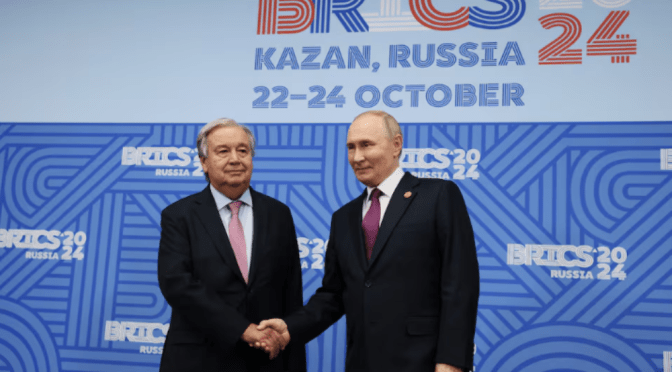
UN Secretary-General Antonio Guterres’s meeting with Vladimir Putin in October, and his absence at the Ukraine Peace Summit in June, raises critical questions about the role of international organisations in addressing conflict: Is the UN a moral arbiter, or should it prioritise dialogue, even with those who perpetrate violence?
By Daniel Raynolds
The debate surrounding UN Secretary-General Antonio Guterres’s 22-24 October attendance at the 2024 BRICS summit—that took place in Kazan, Russia—reveals deep fractures in how international diplomacy is understood and practiced in an increasingly polarised world. On one side, critics argue that Guterres’s cordial engagement with Vladimir Putin is tantamount to endorsing his actions. They assert that such diplomacy undermines the moral authority of the UN, especially in light of ongoing conflicts such as the war in Ukraine.
Alexander J. Motyl, a professor of political science at Rutgers University-Newark, in his article published on The Hill criticizes the Secretary-General for meeting a “war criminal” at the summit. He argues that while Guterres has a duty to engage with world leaders, it is morally wrong for him to appear cordial with dictators like Putin. These actions endorse Putin’s war and diminish the UN’s credibility, particularly at a time when tensions are escalating due to North Korean troops arriving in Russia to support the war in Ukraine.
Should leaders in times of escalating conflict take clear stances that reflect their commitment to justice and accountability? Bahauddin Foizee frames Guterres’s approach as a necessary engagement for peace. His role is not merely to condemn aggression but to foster dialogue among all nations, even those accused of serious crimes.
Sidelining Russia, says Foizee, could jeopardise the UN’s broader mission and limit opportunities for conflict resolution. His perspective highlights the complexity of international relations, where rigid moral absolutism can hinder the nuanced diplomacy required to achieve lasting peace. Foizee also defends Guterres’s absence from Ukraine’s peace summit in Switzerland in June on accord of the need for balance; attending would have necessitated alignment with Western proposals, potentially alienating Russia.
Ihor Petrenko, a Ukraine-based journalist who works as a fixer for foreign media, has been vocal in criticizing Guterres for his meet and greet with Putin. Petrenko argues that Guterres’s decision to meet with Putin, despite the Russian leader being an International Criminal Court fugitive, undermines the credibility of the UN and weakens Ukraine’s position in its struggle for sovereignty. Guterres’s calls for a “just peace” in Ukraine, framed within the principles of the UN Charter, are seen by Petrenko and many in Ukraine as hollow and ineffective, especially given the lack of concrete action from the UN to hold Russia accountable for its aggression.
Petrenko highlights the absurdity of Putin dismissing the war as a “family quarrel” during the summit, a remark that Guterres failed to adequately challenge. Furthermore, like Motyl and Foizee, Petrenko too has drawn a comparison between Guterres’s absence from the Switzerland summit and his acceptance of Putin’s invitation to Kazan, pointing out a troubling bias that harms the UN’s reputation. The Ukraine-based journalist criticizes Guterres for aligning with the very powers that perpetuate the war, arguing, like Motyl, that his actions not only diminish the UN’s moral authority but also contribute to the prolongation of the conflict.
Lithuanian leaders, taking a similar view to Motyl and contrasting to that of Foizee, have sharply criticized Guterres for his meeting with Putin and Belarusian leader Alexander Lukashenko at the summit. Lithuania’s Prime Minister Ingrida Šimonytė and Foreign Minister Gabrielius Landsbergis argue that Guterres’s actions undermine his credibility as an impartial mediator, and,going further, accuse him of moral inconsistency, highlighting his failure to attend a peace summit in Switzerland while choosing to engage with Putin. This, they contend, casts doubt on Guterres’s integrity and role as a genuine advocate for peace, leading Lithuania to call for him to take responsibility for his conduct and, if necessary, step down. The Lithuanian critique reflects growing frustration with Guterres’ perceived lack of principled leadership amid the ongoing war in Ukraine.
These contrasting views underscore a pivotal tension in contemporary global politics: the balance between moral leadership and pragmatic diplomacy. Critics of Guterres fear that engaging with dictators could normalise their actions and erode the UN’s credibility. However, proponents assert that without dialogue, the potential for de-escalation and understanding diminishes.
This dilemma raises critical questions about the role of international organisations in addressing conflict: Is the UN a moral arbiter, or should it prioritise dialogue, even with those who perpetrate violence?
It appears that Guterres’s actions will continue to be scrutinised, reflecting broader anxieties about how the international community navigates the turbulent waters of diplomacy in a world rife with injustice. As the war in Ukraine continues and other global tensions simmer, the challenge for Guterres and his successors will be to find pathways to peace without compromising their moral principles. The effectiveness of the UN, and indeed of global diplomacy itself, may hinge on this delicate balance.
This article was first published on Australian Outlook, a publication of the Australian Institute of International Affairs (AIIA) under a Creative Commons Licence and may be republished with attribution.
Daniel Raynolds writes opinions and reviews about various topics, including human rights violations across the world. He has been published, among others, on The New Federalist, Foreign Policy News, Eurasia Review, International Policy Digest, GAC European Union Politics, Washington Politics Blog, OnLine Opinion (Australia).

 European Union Politics